 adsenservice
Related Articles


Creating a marketing plan can feel like a big task, especially when I have to think about the target audience, content ideas, marketing channels, budget, goals, and performance at the same time. In the past, I would spend a lot of time collecting ideas and organizing them into a proper plan. Today, AI tools can make this process much easier.
I do not see AI as a replacement for marketing knowledge. Instead, I see it as a useful assistant that can help with research, brainstorming, content planning, customer analysis, and many other parts of marketing. The final decisions still need human thinking because every business has different customers and different goals.
In this article, I will explain how to create a marketing plan with AI tools and how I can use AI to make the process faster, more organized, and more practical.
What Is a Marketing Plan?
A marketing plan is a simple roadmap that explains how a business will promote its products or services. It normally includes marketing goals, target customers, competitors, marketing channels, content ideas, budget, timelines, and ways to measure results.
A good marketing plan gives me a clear direction. Instead of randomly posting on social media or creating content without a purpose, I can understand what I want to achieve and what actions I need to take.
AI tools can help with many parts of this process, but I first need to understand the basic goals of my business.
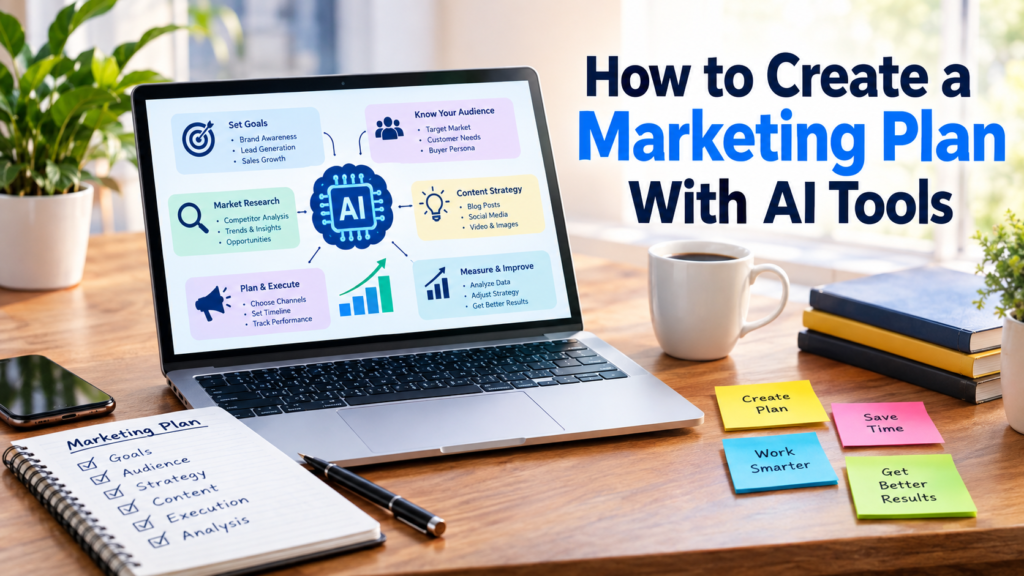
1. Start With Clear Marketing Goals
Before using an AI tool, I always think about what I actually want to achieve.
A business may want to increase website traffic, generate leads, improve brand awareness, increase online sales, gain more customers, or build a social media audience.
For example, instead of telling AI:
“Create a marketing plan for my business.”
I can provide more information:
“Create a three month marketing plan for a small online clothing store. The main goals are to increase website traffic, attract new customers, and improve social media engagement.”
This gives AI a much clearer starting point.
I also prefer setting realistic and measurable goals. When the goal is clear, it becomes easier to decide which marketing activities are worth my time.
2. Understand Your Target Audience
Knowing the target audience is one of the most important parts of marketing. If I do not understand who I am trying to reach, even a creative marketing campaign can struggle.
AI tools can help me create a basic customer profile by considering factors such as age group, interests, common problems, buying behavior, and online habits.
For example, I can ask:
“Create a customer profile for an online store selling affordable fitness clothing to young adults. Include their interests, common concerns, buying motivations, and content preferences.”
The response can give me ideas that I can use as a starting point.
However, I would not treat an AI generated customer profile as actual customer research. I would combine it with real customer feedback, website data, surveys, and other reliable information.
3. Research Your Competitors With AI
Competitor research can take a lot of time when done manually. AI can help organize information and identify areas that deserve further attention.
I can give AI information about competitors and ask it to compare their products, content strategies, customer messaging, pricing approaches, or social media activities.
For example:
“Compare these three competitors based on their content topics, customer offers, social media presence, and website messaging. Identify possible opportunities for a small business.”
This can help me think about the market from different perspectives.
The important thing is to verify information before making business decisions. AI should help organize my research, not replace the research itself.
4. Generate Marketing Ideas
One of the areas where I find AI especially useful is brainstorming.
Sometimes I know my product very well but struggle to think of fresh marketing ideas. AI can quickly generate a large number of possibilities.
I can ask:
“Give me 30 marketing campaign ideas for a small online bakery. Focus on social media, email marketing, seasonal promotions, customer engagement, and local awareness.”
After receiving the ideas, I can select the ones that make sense for my audience and budget.
I do not need to use every idea AI gives me. The purpose is to expand my thinking and find ideas that I may not have considered.
5. Build a Content Marketing Strategy
Content marketing is an important part of many modern marketing plans. AI can help me create a content calendar that supports my main business goals.
For example, I can ask AI to create a monthly content plan containing blog posts, social media posts, videos, emails, and educational content.
A useful prompt could be:
“Create a 30 day content marketing calendar for a small technology website. Include blog topics, social media ideas, short video topics, and educational posts. Keep the content beginner friendly.”
AI can also help me organize content according to different stages of the customer journey.
Some content can introduce the brand. Other content can educate customers, answer questions, demonstrate products, or encourage people to make a purchase.
6. Choose the Right Marketing Channels
I do not believe every business needs to use every marketing platform.
A better approach is to understand where the target audience spends time and then focus on suitable channels.
AI can help me compare different marketing channels based on my goals.
For example, I can ask:
“My target customers are small business owners. Compare SEO, email marketing, Facebook, Instagram, LinkedIn, and short form video for reaching this audience. Explain the potential advantages and limitations of each channel.”
This can give me a starting point for deciding where to focus.
The final decision should still depend on real customer behavior, available resources, budget, and previous marketing results.
7. Create a Marketing Budget
Budget planning is another area where AI can help organize my thoughts.
I can provide my total marketing budget and ask AI to create a basic allocation across different activities.
For example:
“I have a monthly marketing budget of $500. Suggest a simple budget structure for content creation, social media promotion, email marketing, SEO, and paid advertising.”
The response can provide possible allocations, but I would treat them as planning suggestions rather than fixed rules.
I would review actual campaign performance and adjust the budget over time.
8. Create a Marketing Timeline
A marketing plan becomes much easier to follow when I turn it into a timeline.
AI can help me divide a large strategy into weekly or monthly tasks.
For example, the first month could focus on audience research and content preparation. The second month could focus on publishing content and testing campaigns. The third month could focus on analyzing results and improving the strategy.
I can ask AI:
“Turn this marketing strategy into a 12 week action plan. Divide the work into weekly tasks and include content creation, social media, SEO, email marketing, and performance tracking.”
This makes the plan feel more practical because I can see what needs to happen next.
9. Use AI for Marketing Copy
AI tools can also help create first drafts of marketing copy.
I can use them for social media captions, email ideas, product descriptions, advertisements, headlines, landing page copy, and promotional messages.
For example:
“Write five friendly promotional email ideas for an online bookstore. Keep them useful and natural rather than overly sales focused.”
I can then edit the suggestions to match my brand voice.
I believe human editing is important here. Marketing copy should sound like the business and should provide genuine value instead of simply trying to persuade people to buy something.
10. Analyze Marketing Performance
Creating a marketing plan is only one part of the process. I also need to know whether the plan is working.
AI can help analyze marketing data when I provide accurate information.
I can use it to identify patterns in website traffic, engagement, conversions, email performance, or campaign results.
For example:
“Analyze this monthly marketing data and identify which channels generated the most traffic and conversions. Explain possible reasons for the differences and suggest areas I should investigate.”
This can make large amounts of information easier to understand.
Still, I make sure that important business decisions are based on accurate data and not only on an AI interpretation.
11. Improve the Marketing Plan Over Time
A marketing plan should not remain exactly the same forever.
Markets change. Customer interests change. New competitors appear. Some campaigns perform better than others.
This is why I prefer treating a marketing plan as a working document.
After each campaign, I can review what happened and ask AI to help me identify possible improvements.
For example:
“Here are the results from my previous campaign. Identify what worked well, what performed poorly, and what questions I should investigate before creating the next campaign.”
This creates a continuous improvement process.
A Simple AI Marketing Plan Prompt
If I want to create a complete starting plan, I can use a prompt like this:
“Create a practical marketing plan for my business. My business sells [product or service]. My target audience is [audience]. My main marketing goal is [goal]. My monthly budget is [budget]. I want to use [marketing channels]. Create a three month strategy with content ideas, weekly activities, suggested marketing channels, measurable goals, and performance tracking suggestions. Use simple language and organize the plan into clear sections.”
The more useful information I provide, the more relevant the response is likely to be.
Final Thoughts
AI tools can make marketing planning much easier, especially when I use them for research organization, brainstorming, content planning, customer analysis, copywriting, and data interpretation.
At the same time, I do not think AI should make every marketing decision for me. A successful marketing plan needs human judgment, real customer information, creativity, testing, and continuous improvement.
For me, the biggest advantage of AI is the time it can save. Instead of starting with a completely blank page, I can use AI to create a starting point and then improve it based on my own knowledge and real business information.
The best approach is to combine AI tools with human experience. Let AI help with the repetitive and research based parts of marketing, while keeping the important strategic decisions under human control.
When used this way, AI can become a practical assistant for creating a marketing plan that is organized, flexible, and focused on real business goals.