 adsenservice
Related Articles


Writing product descriptions can take more time than many people expect. When I have several products to add to an online store, writing a unique, useful, and attractive description for every product can become a repetitive task. This is where AI prompts for creating product descriptions can make the process much easier.
AI writing tools can help generate product descriptions quickly, but the quality of the result depends heavily on the prompt I provide. A simple prompt may produce a basic description, while a detailed prompt can give me content that is more relevant to the product, customer, and brand.
In this article, I will explain how I use AI prompts for product descriptions, what information I include in a prompt, and how I improve AI generated product content before publishing it.
What Are AI Prompts for Product Descriptions?
An AI prompt is simply an instruction that tells an AI tool what I want it to create. When creating product descriptions, the prompt can include information about the product, target audience, features, benefits, tone, keywords, length, and writing style.
For example, instead of asking an AI tool to “write a product description,” I can provide detailed information about the product and explain exactly what kind of description I need.
A useful prompt could tell the AI to write a clear product description for a specific audience, mention important features, explain the benefits, naturally include SEO keywords, and maintain a friendly tone.
The more useful information I provide, the easier it becomes for the AI tool to understand my goal.
Why Product Description Prompts Matter
I believe the biggest advantage of using AI prompts is consistency. When I have dozens or hundreds of products, maintaining a similar writing style across all product pages can be difficult when everything is written manually.
AI can help create a starting point for each description while following the same instructions.
Another advantage is speed. Instead of spending a long time creating the first draft, I can provide the product details and receive a draft within a short time.
However, I do not recommend publishing every AI generated description without reviewing it. AI can sometimes misunderstand product information or add details that were not provided. Human editing is still important.
Include Complete Product Information
One of the first things I focus on when creating AI prompts for product descriptions is providing accurate product information.
I usually include the product name, category, material, size, color, specifications, main features, benefits, intended use, and other important details.
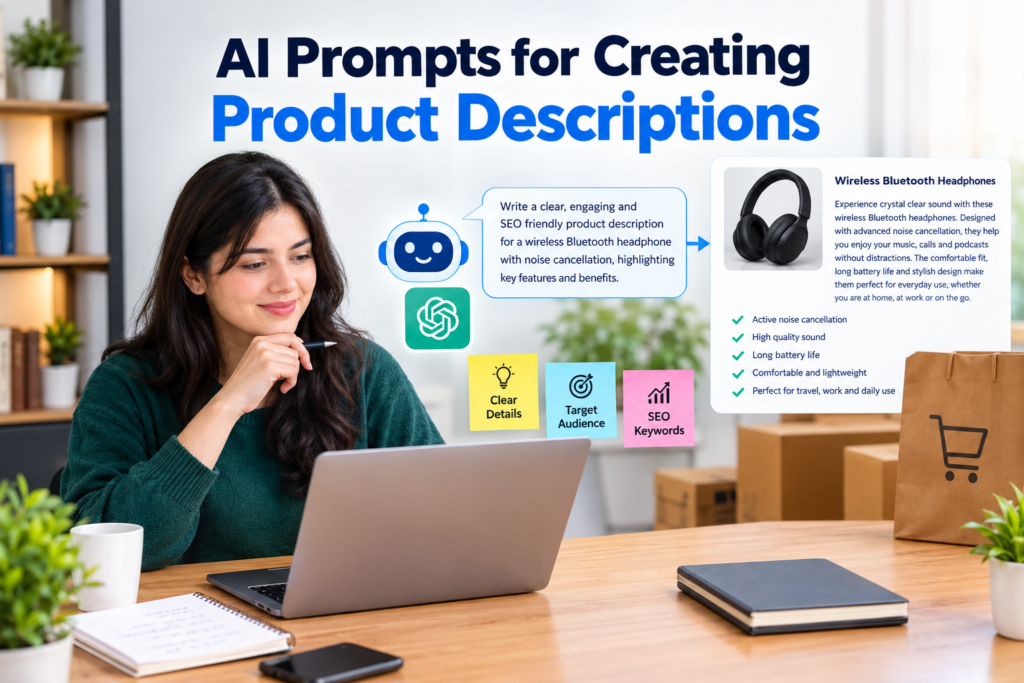
For example, if I am creating a description for wireless headphones, I might provide information about battery life, Bluetooth connectivity, noise cancellation, weight, charging method, and compatibility.
This gives the AI enough information to create a useful description without relying on assumptions.
I always make sure that the information I provide is accurate because the final description should represent the actual product.
Tell AI Who the Customer Is
A product description should speak to the people who may actually buy the product. That is why I like to include the target audience in my AI prompts.
For example, the audience could be students, professionals, parents, travelers, fitness enthusiasts, gamers, or small business owners.
The same product can be described differently depending on the audience.
A laptop designed for students may need a description focused on portability, battery life, affordability, and everyday study tasks. A laptop designed for professionals may require more emphasis on performance, productivity, storage, and business use.
When I tell AI who the intended customer is, the description usually becomes more relevant.
Use AI Prompts for SEO Product Descriptions
SEO is another important part of product content. A product page needs useful information for customers, but it can also benefit from naturally using relevant search terms.
When creating an SEO product description with AI, I provide the main keyword and related terms. I also ask the AI to use them naturally rather than repeating the same keyword unnecessarily.
For example, if I am selling a particular type of backpack, the prompt could include terms such as travel backpack, laptop backpack, lightweight backpack, and waterproof backpack if those terms accurately describe the product.
I avoid keyword stuffing because product descriptions should be written for real people first.
Create Prompts for Different Writing Styles
Different brands have different personalities. Some stores use a professional tone, while others prefer friendly, simple, energetic, or luxurious language.
I can mention the preferred tone directly in the prompt.
For example, I might ask AI to write a product description in a friendly and conversational tone using simple English. For a premium brand, I might request a polished and sophisticated tone.
Giving the AI a clear style instruction can make product descriptions feel more consistent with the rest of the website.
Useful AI Prompt Formula
A simple formula I use for product description prompts is:
Product information + target customer + key benefits + tone + SEO keywords + length + formatting requirements.
For example, a prompt could look like this:
“Write a 150 word product description for a lightweight waterproof travel backpack. The target audience is frequent travelers and students. Highlight the laptop compartment, comfortable straps, storage capacity, and water resistant material. Use a friendly and professional tone. Naturally include the keywords travel backpack, laptop backpack, and lightweight backpack. Make the description easy to read and focused on customer benefits.”
This type of prompt gives the AI much more direction than a short request.
Focus on Benefits Instead of Only Features
One mistake I often see in product descriptions is focusing only on features.
Features tell customers what a product has. Benefits explain why those features matter.
For example, “The backpack has padded shoulder straps” is a feature. Explaining that the padded straps can make carrying the backpack more comfortable gives the customer a reason to care about that feature.
When creating AI prompts, I therefore ask the tool to explain important features through customer benefits.
This can make the description more useful and persuasive without making it sound overly promotional.
Ask AI to Create Multiple Versions
Sometimes the first AI generated product description does not match the style I want. Instead of starting again from the beginning, I can ask the AI to create another version.
I might request a shorter version for an online marketplace, a more detailed version for an ecommerce website, or a more conversational version for social media.
I can also ask for several opening sentences and then choose the one that fits my product best.
This makes AI useful as a writing assistant rather than simply a content generator.
Keep Product Descriptions Easy to Read
Online shoppers usually want to understand a product quickly. Large blocks of text can make product pages difficult to scan.
When I create AI prompts, I can ask for short paragraphs, simple sentences, useful headings, and bullet points for important features.
For example, I might ask AI to provide a short introduction followed by key features and a final paragraph explaining who the product is suitable for.
Good formatting can improve the reading experience and make important information easier to find.
Always Check AI Generated Content
Even when an AI tool produces a polished description, I always recommend checking the content before publishing it.
The most important thing I check is factual accuracy. I make sure that the AI has not added a feature, material, specification, warranty, or benefit that the product does not actually have.
I also check grammar, tone, keyword placement, product names, measurements, and spelling.
AI can create convincing text, but convincing text is not always accurate text. Human review is therefore an important part of the process.
Avoid Making Descriptions Sound Generic
One challenge with AI product descriptions is that they can sometimes sound similar. Words such as high quality, perfect choice, exceptional, amazing, and innovative can easily become repetitive.
To make descriptions more natural, I provide specific product details and ask the AI to avoid generic promotional language.
I also like to edit the final version myself. Adding real details about the product can make the description feel more authentic.
The goal should be to create content that sounds like it was written specifically for that product.
Use AI to Improve Existing Descriptions
AI prompts are not only useful for writing descriptions from scratch. I can also use them to improve product content that already exists.
For example, I can provide an old product description and ask AI to make it clearer, shorter, more customer focused, or more SEO friendly while keeping all factual information unchanged.
This is particularly useful for online stores with older product pages.
I can also ask AI to identify unclear sentences or missing information and suggest improvements.
AI Prompts Can Save Time
For ecommerce businesses, time is valuable. Writing product descriptions manually for a large catalog can require significant effort.
AI prompts can help speed up the first draft process. Once I create a reliable prompt template, I can reuse the structure for different products by changing the product information.
This creates a repeatable workflow. I provide accurate information, generate a draft, review the content, make necessary edits, and then publish the final version.
This approach gives me the benefits of AI while keeping human control over the final content.
Final Thoughts
AI prompts for creating product descriptions can be extremely useful for ecommerce stores, marketers, bloggers, and online sellers. The key is not simply asking an AI tool to write something about a product. The quality of the prompt plays an important role in determining the quality of the result.
From my point of view, a good product description prompt should include accurate product information, the target audience, important features, customer benefits, desired tone, SEO keywords, length, and formatting instructions.
I also believe that AI should be used as a helpful writing assistant rather than a replacement for human judgment. After generating a product description, I always recommend checking the facts, improving the wording, removing unnecessary claims, and making sure the final content accurately represents the product.
With the right AI prompts and a proper editing process, creating product descriptions can become faster, more consistent, and much easier. The most useful approach is to experiment with different prompts, learn what works for your products, and gradually create a prompt structure that fits your own content workflow.