 adsenservice
Related Articles



Creating content consistently sounds easy until you actually have to plan what to publish every day. I have found that the hardest part of content marketing is not always writing the content. It is deciding what to create, when to publish it, which platform to use, and how to keep everything organized.
This is where AI tools for creating content calendars can make a big difference.
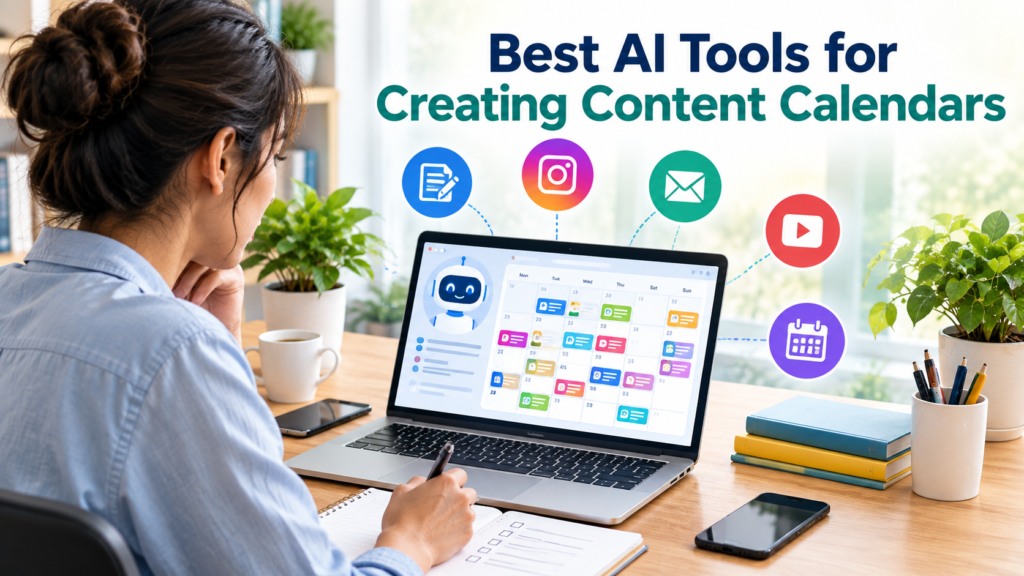
An AI content calendar can help generate topic ideas, organize publishing dates, suggest content formats, create social media ideas, and keep a marketing plan organized. Instead of staring at a blank calendar, I can use AI to create a starting point and then adjust it according to my audience and goals.
There are many content calendar tools available today. Some focus on social media scheduling, while others are designed for editorial planning, team collaboration, SEO, or visual content. In this article, I will discuss some useful AI tools for creating content calendars and explain how I would use them in a practical content workflow.
What Is an AI Content Calendar?
An AI content calendar is a digital planning system that uses artificial intelligence to help organize content ideas and publishing schedules.
A traditional content calendar usually contains information such as the title, publishing date, platform, content type, status, and assigned person. An AI powered content calendar can take this a step further by helping generate ideas, suggest topics, create captions, organize campaigns, and sometimes recommend publishing times.
For example, if I run a technology website, I can provide information about my audience and ask an AI tool to create a monthly content plan around artificial intelligence, software, productivity, and technology trends.
The AI can give me dozens of ideas, but I still decide which topics are actually useful for my readers.
Why Use AI for Content Planning?
The biggest benefit I see is saving time.
Planning content manually can take several hours, especially when you publish on multiple platforms. AI can help turn a general idea into a structured plan much faster.
Another benefit is consistency. When I have a calendar in front of me, it becomes easier to see whether I am publishing too much of one type of content or ignoring an important topic.
AI can also help when I run out of ideas. Instead of repeatedly asking myself what to publish next, I can ask an AI tool for topic suggestions based on my niche, audience, keywords, and previous content.
According to current content calendar guidance, tools differ considerably between editorial planning, social publishing, collaboration, and design workflows, so choosing based on your actual workflow is important.
1. Notion AI
Notion is one of the most flexible options for building a content calendar. It allows users to create databases, calendar views, documents, notes, and content workflows in one workspace.
What I like about Notion is the flexibility. I can create columns for title, keyword, content type, author, publishing date, status, platform, and notes. I can then switch between different views depending on what I need.
Notion AI can also help with brainstorming, summarizing information, rewriting text, and developing content ideas.
I would consider Notion especially useful for bloggers, website owners, freelancers, and teams that want to build their own customized content planning system.
The main thing to remember is that Notion is primarily a flexible planning workspace rather than a complete social publishing platform. Current comparisons also note that its strength is customizable planning while native social publishing is not its main focus.
2. Buffer
Buffer is useful when your content calendar is mainly focused on social media.
Its calendar and scheduling features allow users to organize posts across social channels. Buffer also provides AI assistance for generating and improving social content.
For me, the biggest advantage of a tool like Buffer is simplicity. A content calendar should make publishing easier, not create another complicated task.
I can prepare social media ideas, write captions, schedule them, and then review the calendar to see what is coming next.
Buffer can be particularly useful for bloggers, creators, small businesses, and marketers who want a straightforward way to manage social publishing. Current 2026 comparisons describe Buffer as a simple option for solo creators and small teams that need scheduling and light AI assistance.
3. Hootsuite
Hootsuite is designed for more advanced social media management. Its content calendar works alongside scheduling, analytics, collaboration, and other social media management features.
This can be useful when a business manages several social media accounts and needs more control over the publishing process.
For example, a marketing team can plan posts, assign responsibilities, review content, schedule campaigns, and monitor performance.
Hootsuite also includes AI related features that can assist with content creation. Its current platform is positioned around publishing, analytics, collaboration, and AI assisted social media workflows.
I would look at a tool like Hootsuite when the content calendar is part of a larger social media operation rather than just a personal publishing list.
4. Canva
Canva is well known for graphic design, but it can also play an important role in content planning.
This is particularly helpful if most of your content includes images, videos, presentations, social posts, or other visual material.
One workflow I like is creating the graphic and planning the post in the same environment. This can reduce the number of separate tools needed to move content from design to publishing.
Canva’s Content Planner allows users to plan social content, while its design tools make it possible to create the visual assets that go with those posts. Current content calendar comparisons describe Canva as especially useful for creators and small teams that combine visual design with content planning.
5. Later
Later is another useful option for visual social media planning.
Its calendar and visual planning features are particularly relevant for platforms where the appearance of the feed matters. This can help creators and brands understand how posts will look together instead of looking at individual posts separately.
I would consider Later when the content strategy depends heavily on photos, short videos, product images, and other visual content.
Current tool comparisons highlight Later’s visual calendar, media library, feed preview, and social scheduling features.
6. CoSchedule
CoSchedule is focused on marketing and editorial planning. It can be useful when you are managing several content types as part of larger campaigns.
For example, one campaign might include a blog post, email newsletter, social media posts, video content, and promotional material.
Instead of treating every piece of content as a separate task, a marketing calendar can help connect them together.
This approach is useful because successful content marketing is often about campaigns rather than random individual posts. Current content planning comparisons place CoSchedule among tools designed around campaign and editorial planning.
7. Asana
Asana is primarily a project management platform, but it can also work well as a content calendar.
I find project management tools useful when several people are involved in creating content.
A content task can have an assigned person, deadline, status, notes, and supporting information. A calendar view can then show the publishing schedule.
For example, a blog post might move through several stages such as idea, research, writing, editing, design, approval, and publishing.
Asana can be useful for marketing teams that want content planning to be connected with their broader project management workflow. Current comparisons identify its calendar, task assignments, workflow management, and multiple project views as useful for marketing teams.
8. ChatGPT for Content Ideas
Although a general AI assistant is not necessarily a complete content calendar platform, it can be extremely useful for building the ideas that go into a calendar.
For example, I can provide my niche and ask for thirty blog topics, twenty social media ideas, seasonal content suggestions, or different content ideas based on a particular keyword.
I can also ask AI to organize those ideas into categories such as educational content, promotional content, comparison articles, tutorials, frequently asked questions, and opinion based posts.
After that, I can transfer the selected ideas into my actual calendar.
This gives me more control because I am not depending on one platform for everything.
How I Would Build an AI Content Calendar
If I were creating a content calendar from scratch, I would start with my main goal.
For example, my goal might be increasing website traffic, building an email list, promoting a product, or growing a social media audience.
Next, I would identify my main content categories.
For a technology website, these could include AI tools, tutorials, software guides, productivity, comparisons, and technology tips.
Then I would use AI to generate topic ideas around each category.
After collecting the ideas, I would remove topics that are too similar and prioritize the ones that provide the most value to my audience.
Finally, I would add the selected topics to a calendar and assign dates, platforms, content formats, and publishing responsibilities.
This process is much better than simply asking AI to generate hundreds of random ideas.
What Features Should You Look For?
Before choosing an AI content calendar tool, I recommend checking the features you actually need.
Look for calendar views, AI idea generation, scheduling, collaboration, content status tracking, social media integration, analytics, templates, and automation.
If you are a solo creator, you may not need an expensive enterprise platform.
If you manage a marketing team, approval features and collaboration may be more important.
If your content is highly visual, a tool such as Canva or Later may fit your workflow better.
If you manage blogs, email campaigns, social media, and larger marketing projects, a flexible planning platform may be more useful.
The right tool depends on your workflow, team size, budget, and publishing channels.
Do Not Let AI Control the Entire Calendar
AI can create a content calendar quickly, but I would not recommend publishing everything it suggests.
An AI system does not automatically understand your audience as well as you do.
Some ideas may be repetitive. Others may not fit your brand. Some topics may be outdated or irrelevant.
That is why human review remains important.
I prefer to use AI for speed and brainstorming while keeping the final decisions under my control.
The goal should not be creating the largest possible calendar. The goal should be creating a useful calendar filled with content that people actually want to read or watch.
Final Thoughts
The best AI tools for creating content calendars can make content planning much easier. Notion is useful for flexible editorial planning, Buffer is practical for social scheduling, Hootsuite provides broader social media management, Canva combines visual creation with planning, Later focuses strongly on visual social content, while CoSchedule and Asana can support larger marketing workflows.
From my point of view, the best content calendar is not necessarily the one with the most features. It is the one that I can actually use consistently.
AI can give me ideas, organize information, suggest formats, and reduce repetitive work. But I still need to understand my audience, choose useful topics, check information, and decide what deserves to be published.
When AI and human creativity work together, content planning becomes less stressful and much more organized. Instead of wondering what to publish every morning, I can open my calendar and already know what is coming next.