 adsenservice
Related Articles


Artificial intelligence has become a useful part of everyday life. From writing and research to education, business, coding, image creation, and customer support, AI tools can save time and help people work more efficiently. However, I believe that using AI is not only about knowing which tool to use. It is also about knowing how to use AI tools responsibly.
AI can provide impressive answers, but it is not perfect. Sometimes it can provide incorrect information, misunderstand a question, or produce content that sounds convincing but is not actually true. That is why responsible AI use requires human judgment, privacy awareness, fact checking, and ethical thinking.
In this article, I will explain some practical ways to use AI tools responsibly while getting the most value from them.
What Does Responsible AI Use Mean?
Responsible AI use means using artificial intelligence in a way that is safe, honest, ethical, and useful. In my view, the most important thing to understand is that AI should be treated as a tool rather than a replacement for human thinking.
For example, you can use an AI writing tool to generate ideas, improve grammar, create an outline, or make a difficult paragraph easier to understand. But you should still read the final content and make sure it represents your own thoughts and meets your requirements.
Responsible AI use also means understanding the limitations of the technology. Just because an AI tool gives you an answer does not mean the answer is automatically correct.
1. Always Check AI Generated Information
One of the most important rules for using AI tools responsibly is to verify important information.
AI systems can sometimes produce inaccurate facts, outdated information, incorrect statistics, or references that do not exist. This can be especially problematic when you are using AI for education, business, finance, legal matters, health information, or professional work.
Whenever the information is important, I recommend checking it against reliable sources. Look for official websites, trusted publications, academic sources, or primary documents when appropriate.
AI can help you find and understand information, but the responsibility for using that information still belongs to you.
2. Protect Your Personal Information
Privacy is another major part of responsible AI use.
People sometimes enter personal information into AI tools without thinking about the consequences. This can include phone numbers, passwords, financial information, identification documents, private conversations, business information, or confidential files.
I believe it is better to avoid sharing sensitive information unless you clearly understand how the particular AI service handles that information.
Before uploading a document, ask yourself whether the AI tool actually needs all of its contents. If personal or confidential information is not necessary for the task, remove it first.
A simple rule is useful here: do not share sensitive information with an AI tool just because it makes the task slightly easier.
3. Use AI to Support Your Thinking
AI tools are excellent for brainstorming and organizing ideas, but depending on them for every decision can reduce your own involvement.
For example, if I am writing an article, I can ask AI to suggest topics or improve the structure. However, I would still want the main ideas, opinions, examples, and final decisions to reflect my own understanding.
This approach makes AI more useful because it works as an assistant.
You can ask AI questions such as:
- Give me ideas for this topic.
- Explain this concept in simple language.
- Help me organize these points.
- Find weaknesses in my argument.
- Suggest ways to improve this paragraph.
These uses allow AI to support human creativity instead of completely replacing it.
4. Do Not Copy AI Content Blindly
Another important part of responsible AI use is originality.
AI can generate articles, essays, social media posts, product descriptions, and other forms of content within seconds. But publishing everything exactly as generated is not always a good approach.
I prefer to treat AI generated content as a starting point. After receiving an answer, I can review it, add my own knowledge, remove unnecessary information, correct mistakes, and make the writing sound natural.
This is particularly important for bloggers and website owners. Good content should provide real value to readers instead of simply filling a website with automatically generated text.
AI can help with content creation, but human experience and genuine knowledge are what make content useful.
5. Understand AI Bias
AI tools learn from large amounts of information, and the information used to develop or operate AI systems can contain different perspectives and biases.
This means an AI response should not automatically be treated as completely neutral.
When dealing with controversial, social, cultural, historical, or sensitive topics, it is useful to consider different sources and perspectives. Ask yourself whether the answer provides enough context and whether important viewpoints may be missing.
Responsible AI use means being willing to question the output instead of accepting everything immediately.
6. Use AI Ethically
Technology can be used for positive purposes, but people can also misuse it.
For me, responsible AI use means avoiding activities that involve deception, fraud, harassment, manipulation, privacy violations, or other harmful behavior.
For example, using AI to improve a legitimate business email is very different from using AI to create deceptive messages designed to trick people.
The fact that an AI tool can perform a particular task does not automatically mean that the task should be performed.
Before using AI, consider the purpose and possible consequences of the result.
7. Be Careful With AI in Education
AI tools have become especially popular among students. They can explain difficult subjects, provide examples, help with brainstorming, and support learning.
However, students should avoid using AI as a shortcut for learning.
If a student asks AI to complete every assignment and submits the result without understanding it, the student may receive an answer but miss the actual learning experience.
A better approach is to use AI as a study assistant. Ask it to explain a difficult topic, create practice questions, test your knowledge, or identify areas that need more study.
This way, AI can support education without replacing the student’s own learning process.
8. Review AI Generated Images and Videos
AI is not limited to text. Today, people can create realistic images, videos, audio, and other digital content using artificial intelligence.
This creates another responsibility: clearly understanding what is real and what is artificially generated.
When creating content for a website or social media, avoid using AI generated media in ways that could mislead people. If realistic synthetic content could reasonably be mistaken for real events or real people, transparency becomes particularly important.
Creators should also respect copyright, privacy, personality rights, and the rules of the platforms where they publish their work.
9. Choose the Right AI Tool for the Job
There are many AI tools available, and each one has different strengths.
Some are designed for writing, some for coding, some for research, some for image generation, and others for data analysis or productivity.
Instead of using the first AI tool you find, think about what you actually need.
For example, if your goal is to understand a complicated subject, you may need an AI tool that provides strong explanations and research support. If your goal is editing text, a writing focused tool may be more appropriate.
Choosing the right tool can improve both the quality and efficiency of your work.
10. Keep Human Responsibility in the Process
Perhaps the most important point is that AI does not remove human responsibility.
If an AI tool makes a mistake, the person using the information still needs to recognize and correct it. This is particularly important when AI is used for decisions that can significantly affect people.
I think the healthiest approach is to keep a human involved in important decisions. AI can provide suggestions, summaries, calculations, ideas, and different possibilities, but people should remain responsible for reviewing and deciding how those outputs are used.
Final Thoughts
AI tools can be extremely helpful when they are used thoughtfully. They can save time, improve productivity, support creativity, and make complicated information easier to understand.
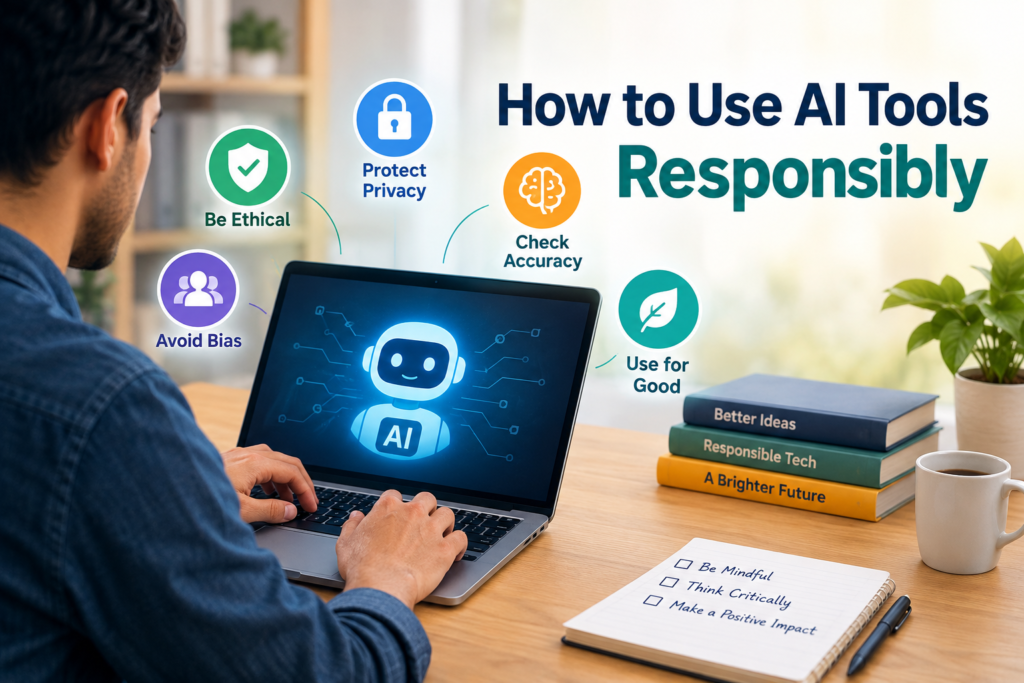
At the same time, responsible AI use requires more than simply knowing how to write a good prompt. We need to check information, protect privacy, respect originality, recognize potential bias, use AI ethically, and maintain our own critical thinking.
In my opinion, the best way to use AI is to think of it as a helpful assistant. Let AI handle repetitive tasks, generate ideas, explain concepts, and help you improve your work. But keep your judgment, experience, creativity, and responsibility in the process.
The future of AI will depend not only on how powerful these tools become, but also on how responsibly people choose to use them. When we combine artificial intelligence with human judgment, we can use technology more effectively while reducing unnecessary risks.