 adsenservice
Related Articles



Practicing questions and answers is one of the simplest ways to improve understanding and prepare for exams, interviews, presentations, and everyday learning. I have found that reading information again and again does not always mean that I actually remember it. When I test myself with questions, I can quickly discover what I understand and what I still need to study.
This is where useful prompts can make practice easier. With the right prompt, an AI tool can create questions based on a topic, adjust the difficulty, explain incorrect answers, and even act like a teacher or interviewer. Instead of waiting for someone else to prepare questions, I can create a practice session whenever I need one.
In this article, I will explain how to use prompts for practicing questions and answers and share practical prompt ideas that students, professionals, and anyone who wants to learn can use.
Why Question and Answer Practice Is Useful
Question and answer practice encourages active learning. Instead of simply looking at information, you have to recall it and use it.
For example, after reading a chapter about biology, you can close your notes and ask yourself questions about the main concepts. If you cannot answer a question, you immediately know which area needs more attention.
This method can be useful for:
Exam preparation
Job interviews
Language learning
General knowledge
Professional training
Public speaking
Technical subjects
Certification preparation
The important part is to make the questions match your learning goal.
Start With a Clear Topic
A good practice prompt should tell the AI exactly what you want to study.
A basic prompt such as “Ask me questions about science” is too broad. You will probably get a mixture of subjects and difficulty levels.
A better prompt would be:
“Create 15 practice questions about photosynthesis for a high school student. Include a mixture of basic, intermediate, and challenging questions.”
This gives the tool a specific subject and audience.
The more specific your prompt is, the more useful the questions are likely to be.
Prompt for Multiple Choice Questions
Multiple choice questions are useful when preparing for tests and quizzes.
You can ask an AI tool to create questions with several answer options.
Try this prompt:
“Create 20 multiple choice questions about basic computer networking. Give four options for each question and provide the correct answers at the end. Do not reveal the answers immediately after each question.”
Keeping the answers separate allows you to test yourself without accidentally seeing the solution.
You can also ask for explanations after completing the quiz.
Prompt for Short Answer Questions
Short answer questions require you to recall information without choosing from options.
This can provide a stronger test of your memory.
Try:
“Create 15 short answer questions about the topic. Do not provide the answers until I respond. After I answer, tell me whether my response is correct and explain anything I missed.”
This creates a more interactive practice session.
I particularly like this approach because it encourages me to think before looking at the answer.
Prompt for Difficult Questions
Once you understand the basics, you should increase the difficulty.
You can ask:
“Create 10 challenging questions about this topic. Focus on application, reasoning, and problem solving instead of simple definitions.”
This is useful because exams and professional assessments often require more than memorization.
You can also ask the AI to gradually increase the difficulty after every few questions.
Prompt for Beginner Practice
If you are completely new to a subject, difficult questions can be discouraging.
Start with simple questions that help establish the basics.
For example:
“Act as a friendly tutor. Ask me 10 beginner questions about personal finance one at a time. Wait for my answer before asking the next question. Explain the correct answer in simple language.”
This creates a conversational learning experience.
It can also help identify areas where your basic understanding needs improvement.
Prompt for Interview Practice
Question and answer prompts are not limited to academic subjects. They can also help with job interview preparation.
You can ask:
“Act as a job interviewer for a junior content writer position. Ask me one interview question at a time. Wait for my answer, then give constructive feedback and ask the next question.”
This allows you to practice answering questions before a real interview.
You can also specify the type of interview, job role, experience level, and industry.
Prompt for Technical Interview Questions
Technical interviews often require a combination of knowledge and problem solving.
A useful prompt could be:
“Act as a technical interviewer. Ask me 15 questions about basic web development. Start with simple questions and gradually increase the difficulty. Do not provide the answer until I respond.”
This gives you an opportunity to practice under conditions that feel more like an actual interview.
Afterward, you can ask for feedback about areas that need improvement.
Prompt for Exam Preparation
When preparing for an exam, it helps to focus on the material that is actually relevant.
You can provide the subject and specific chapters.
For example:
“Create a practice test based on chapters 3, 4, and 5 of this subject. Include multiple choice, short answer, and application based questions. Make the difficulty similar to a typical school exam.”
If you have your own study material, you can also base your practice questions on those notes or materials.
This helps keep the questions connected to what you actually need to learn.
Prompt for Explaining Wrong Answers
Getting an answer wrong is not necessarily a bad thing. It can show you exactly where you need more practice.
After answering a question incorrectly, try:
“Explain why my answer is incorrect. Give me the correct answer, explain the concept in simple language, and provide one similar practice question.”
This turns a mistake into another learning opportunity.
I think this is one of the most useful ways to use AI for studying because you are not simply collecting correct answers. You are learning from the mistakes you make.
Prompt for Follow Up Questions
Sometimes a basic question is not enough.
You can ask the AI to challenge your answer with a follow up question.
For example:
“After I answer each question, ask me one follow up question that tests whether I truly understand the concept.”
This can reveal whether you understand the subject or simply memorized a particular answer.
It is especially useful for subjects where concepts are connected to one another.
Prompt for Flashcard Questions
Flashcards are another practical way to practice questions and answers.
Try:
“Create 30 flashcards about the key terms in this chapter. Put the question on one side and a short, accurate answer on the other side. Focus on important concepts rather than minor details.”
You can then transfer the questions into your preferred flashcard application or use them directly for revision.
Keep the answers concise so that reviewing the cards does not become overwhelming.
Prompt for Question Difficulty Levels
A useful practice session should not always have the same difficulty.
You can ask for three levels:
“Create 15 questions about this topic. Include five beginner questions, five intermediate questions, and five advanced questions. Keep the questions different from each other.”
This gives you a gradual learning path.
If you can answer the beginner questions but struggle with advanced ones, you have a clear indication of where more practice may be needed.
Prompt for Real World Scenarios
Scenario based questions can help you understand how knowledge applies outside textbooks.
For example:
“Create 10 real world scenarios involving basic cybersecurity. Ask me what I would do in each situation and evaluate my answer.”
This approach can be particularly useful for subjects such as business, technology, healthcare education, communication, and professional training.
Instead of simply remembering facts, you have to apply them to a situation.
Prompt for Language Learning
Questions and answers can also help with language practice.
You could ask:
“Act as an English conversation partner. Ask me simple questions about my daily routine one at a time. Wait for my answer and then correct important grammar mistakes before continuing.”
This provides an opportunity to practice writing and communication at the same time.
You can increase the difficulty as your skills improve.
Prompt for Rapid Revision
When you have limited time, you can create a quick revision session.
Try:
“Give me 20 important questions about this topic for quick revision. Focus on the concepts most likely to be important for understanding the subject. Ask one question at a time and wait for my response.”
This can help you quickly identify what you remember and what you need to review again.
However, quick revision should not replace thorough study when the subject requires deeper understanding.
How to Make Your Prompts Better
The quality of your questions often depends on the quality of your instructions.
When creating prompts, include details such as:
Subject
Topic
Education level
Difficulty
Question type
Number of questions
Answer format
Explanation style
Whether answers should be hidden
For example, instead of saying “Give me questions about history,” say:
“Create 20 questions about the causes of the Industrial Revolution for a beginner student. Include 10 multiple choice questions, five short answer questions, and five application based questions. Hide the answers until I finish.”
This gives much clearer instructions.
Do Not Depend Completely on AI Answers
AI can be useful for practice, but I would still verify important information.
If you are studying for an important exam, compare explanations with your textbook, teacher’s material, official resources, or other reliable sources.
An AI generated answer can sometimes be incomplete or incorrect. The goal should be to use AI as a practice assistant, not as your only source of knowledge.
Create a Regular Practice Routine
The biggest benefit comes from consistent practice.
You do not need to spend hours generating hundreds of questions. A short daily session can be enough to keep important concepts active in your memory.
For example, you could spend 15 minutes answering questions in the morning and another short session reviewing mistakes later in the day.
Keep track of questions you repeatedly get wrong. Those topics deserve additional attention.
Final Thoughts
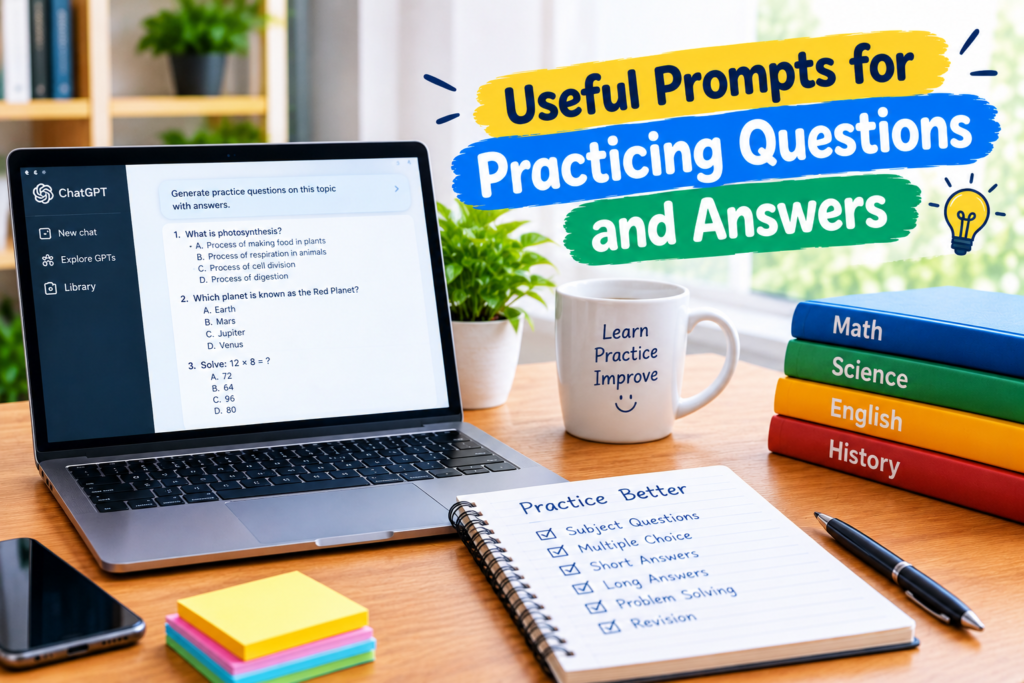
Useful prompts for practicing questions and answers can make learning more active and engaging. Instead of simply reading information, you can test your memory, identify weak areas, practice problem solving, and receive explanations for mistakes.
From my point of view, the most effective prompts are specific. Tell the AI what subject you are studying, who you are, how difficult the questions should be, what format you want, and how you want feedback.
Start with simple questions and gradually increase the difficulty. Practice different question types, including multiple choice, short answer, scenario based, and interview questions.
Most importantly, do not focus only on getting the right answer. Focus on understanding why the answer is correct. When you use prompts in this way, question and answer practice becomes a useful part of a consistent learning routine.