 adsenservice
Related Articles


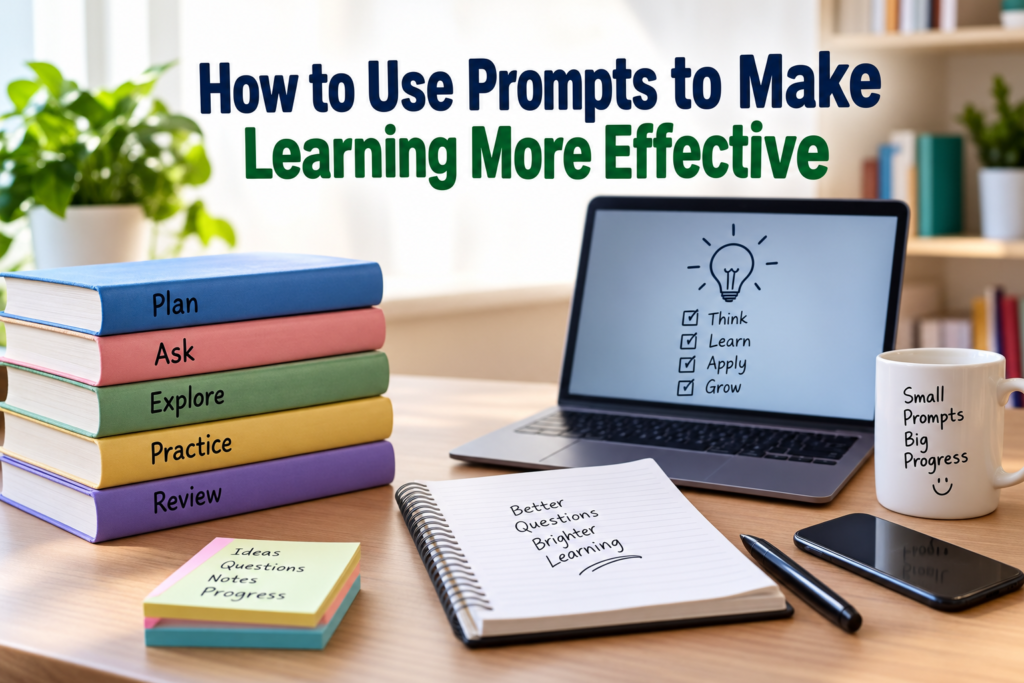
Learning has changed a lot with the growth of digital tools and artificial intelligence. Today, students, teachers, professionals, and even people learning new skills on their own can use prompts to make the learning process more organized and interactive. In my experience, the quality of the question we ask often affects the quality of the answer we receive. This is why learning how to use prompts properly can make studying easier, faster, and more effective.
A prompt is simply an instruction or question given to an AI tool to get a useful response. However, a good learning prompt is more than just asking for an answer. It can help explain difficult topics, create practice questions, identify mistakes, summarize information, and encourage deeper thinking.
In this article, I will explain how to use prompts for learning, how to write better prompts, and how students and lifelong learners can use them responsibly.
What Is a Learning Prompt?
A learning prompt is an instruction designed to help you understand, practice, or explore a particular subject. Instead of simply asking an AI tool to give you information, you can tell it how you want to learn.
For example, instead of asking:
“Explain photosynthesis.”
You could ask:
“Explain photosynthesis in simple language for a beginner, then give me five questions to test my understanding.”
The second prompt gives the AI more direction. It tells the tool what level of explanation you need and what you want to do after learning the topic.
This simple difference can make a significant improvement in the learning experience.
Why Prompts Can Make Learning More Effective
One major advantage of using prompts for learning is personalization. Everyone learns differently. Some people prefer simple explanations, while others understand a subject better through examples, questions, comparisons, or practical exercises.
Prompts allow you to request the learning style that works best for you.
You can ask for:
Simple explanations
Real world examples
Step by step instructions
Practice exercises
Quizzes
Flashcards
Summaries
Analogies
Study plans
Revision questions
This makes AI learning tools more flexible than simply reading a fixed explanation.
Another benefit is immediate feedback. When you are studying alone, it can sometimes be difficult to know whether you actually understand something. A well designed prompt can ask the AI to test your knowledge and explain your mistakes.
Start With a Clear Learning Goal
Before writing a prompt, I recommend deciding what you actually want to learn. A vague goal usually produces a vague response.
For example, if you are learning English, your goal might be improving vocabulary. If you are studying mathematics, your goal might be understanding algebraic equations.
Instead of writing:
“Teach me math.”
Try:
“I am learning basic algebra. Explain linear equations for a beginner and then give me five practice problems.”
This prompt gives the learning tool a clear direction.
A useful learning prompt usually answers three questions:
What am I learning?
What is my current level?
What do I want to achieve?
Once these details are clear, the response is usually much more useful.
Tell the AI Your Learning Level
One of the simplest ways to improve an educational prompt is to mention your current knowledge level.
You can say:
“I am a complete beginner.”
“I already understand the basics.”
“Explain this at a high school level.”
“I am preparing for an advanced exam.”
This prevents the explanation from being unnecessarily complicated or too basic.
For example, a beginner learning computer programming could ask:
“I am new to Python. Explain variables using simple examples and then give me three small exercises.”
Someone with more experience could instead ask:
“I understand Python fundamentals. Explain how variable scope works and give me practical examples involving functions.”
The topic is the same, but the prompts are designed for different learners.
Ask for Step by Step Explanations
When a subject feels complicated, asking for a step by step explanation can make it easier to understand.
For example:
“Explain how compound interest works step by step. Start with the basic idea, show the formula, and then solve one example.”
This approach breaks a large concept into smaller parts.
I find this particularly useful for subjects involving calculations, technical processes, programming, science, and business concepts.
Instead of trying to understand everything at once, you can learn one stage and then move to the next.
Use Prompts to Create Practice Questions
Reading an explanation does not always mean that you have learned the topic. Practice is an important part of learning.
You can use prompts to create questions based on what you have studied.
For example:
“Create ten multiple choice questions about the water cycle. Do not show the answers until I respond.”
This turns the learning process into an active exercise.
You can also request different levels of difficulty:
“Give me five beginner questions, five intermediate questions, and five advanced questions.”
This can help you gradually build confidence.
Use the Socratic Learning Method
Another useful approach is asking AI to guide you through questions instead of immediately giving you the answer.
For example:
“Teach me about supply and demand using questions. Ask me one question at a time and wait for my answer before continuing.”
This method encourages active thinking.
If you are solving a problem, you can also ask:
“Do not give me the final answer immediately. Give me a hint and help me find the solution myself.”
This is an important way to use AI as a learning assistant rather than simply using it to complete your work.
Ask for Examples and Analogies
Some concepts are difficult because they are too abstract. Examples and analogies can make them easier to understand.
For example:
“Explain cloud computing using a simple real world analogy.”
Or:
“Explain computer memory using an everyday example that a beginner can understand.”
After receiving an analogy, you can ask for a technical explanation as well. This allows you to move from a simple understanding toward a deeper one.
Use Prompts for Active Recall
Active recall means trying to remember information instead of simply reading it again. You can use prompts to create an active recall session.
For example:
“I have studied the human digestive system. Ask me ten questions one at a time to test what I remember. Correct my answers and explain anything I misunderstand.”
This creates a simple interactive study session.
You can also ask for flashcards:
“Create twenty flashcards about the important concepts in this chapter. Put the question first and the answer separately.”
This can be useful during revision.
Ask the AI to Find Your Mistakes
Making mistakes is a normal part of learning. Instead of only asking for the correct answer, ask for an explanation of your mistake.
For example:
“I solved this equation and got 42. Here is my working. Check each step and tell me where I made a mistake.”
This is more educational than simply asking for the final answer.
You can also ask:
“Explain why my answer is incorrect and show me how to avoid this mistake in future problems.”
This helps turn mistakes into learning opportunities.
Create Personalized Study Plans
Prompts can also help organize your study time.
For example:
“I have seven days to prepare for a basic biology test. I can study for one hour each day. Create a realistic study plan covering the most important topics and include daily revision questions.”
A good study plan should match your available time and learning goal.
You can make it more specific by providing your exam date, topics, current knowledge, and preferred study schedule.
Use Prompts to Summarize Learning Material
Long chapters can sometimes feel overwhelming. A prompt can help turn large amounts of information into a manageable summary.
For example:
“Summarize this chapter in simple language. List the five most important concepts, important terms, and three questions I should be able to answer after studying it.”
However, I would not recommend relying only on summaries. The original learning material still matters, especially for exams and subjects where details are important.
Use summaries as a support tool rather than a replacement for proper study.
Improve Your Prompts Step by Step
You do not need to write a perfect prompt on your first attempt.
If the response is too complicated, ask:
“Explain it more simply.”
If it is too short, ask:
“Give me more examples and explain the concept in greater detail.”
If you want practice, ask:
“Now test me without giving me the answers.”
This means prompt writing can become an interactive process.
You can start with a simple question and improve it based on the response.
Avoid Using AI as a Shortcut
One important point I believe every learner should understand is that AI should support learning rather than replace it.
If you ask an AI tool to solve every problem and simply copy the answer, you may finish your work but gain very little understanding.
A better approach is to use prompts that make you think.
Ask for hints.
Ask for questions.
Explain your own answer.
Request feedback.
Ask for examples.
Try solving problems before checking the solution.
This approach keeps you actively involved in the learning process.
Verify Important Information
AI tools can sometimes provide incorrect or incomplete information. For this reason, important educational information should be checked against reliable textbooks, official sources, academic materials, or your teacher’s instructions.
This is especially important for medical, scientific, legal, financial, and other subjects where accuracy matters.
A useful prompt can even ask:
“Explain which parts of this answer may require verification and suggest reliable types of sources I should check.”
The goal should be to use AI thoughtfully rather than accepting every response automatically.
Useful Prompt Formula for Learning
A simple formula can help you create better learning prompts:
Topic + Level + Goal + Format + Practice
For example:
“I am a beginner learning digital marketing. Explain SEO in simple language. Give me practical examples and finish with ten questions to test my understanding.”
This prompt clearly communicates what you want.
You can adapt the same structure to almost any subject.
Final Thoughts
Learning how to use prompts effectively can change the way we study. Instead of treating AI as a machine that simply provides answers, I think it is more useful to treat it as an interactive learning assistant.
The best prompts encourage explanation, practice, questioning, feedback, and reflection. They help you study according to your level and focus on the areas where you need the most support.
Start with a clear learning goal, explain your current level, ask for the format you prefer, and use practice questions to test yourself. Most importantly, do not be afraid to improve your prompt when the first response is not exactly what you need.
When used responsibly, prompts can make learning more personal, interactive, and organized. The real value does not come from asking more questions. It comes from asking better questions and actively thinking about the answers.