 adsenservice
Related Articles



Creative work has changed a lot in recent years. Today, artificial intelligence can help people turn simple ideas into images, videos, designs, written content, music, and many other forms of creative work. You do not always need expensive software or years of professional experience to start a creative project.
From my point of view, the biggest benefit of AI tools is that they help reduce the time spent on repetitive tasks. Instead of starting everything from a blank page, I can use AI to generate ideas, explore different styles, improve existing work, and create a starting point that I can customize.
There are now many AI tools for creative projects, and each one has a different purpose. Some are focused on writing, some are designed for images, while others are useful for graphic design, video creation, presentations, and audio. Choosing the right tool depends on the type of project you are working on.
In this article, I will discuss some of the best AI tools for creative projects and explain how they can be useful for beginners, content creators, students, bloggers, marketers, and other creative users.
Why Use AI for Creative Projects?
One of the main reasons I like using AI in creative work is the speed it provides. A creative project can involve research, brainstorming, writing, editing, designing, and many other small tasks. AI can help with several of these steps.
For example, if I want to create a social media campaign, I can use AI to brainstorm ideas, write possible captions, generate visual concepts, and prepare design ideas. This does not mean that AI should make every decision. I still need to review and improve the results.
Another advantage is experimentation. Sometimes the hardest part of a creative project is knowing where to begin. AI can give you several possibilities, allowing you to choose a direction and develop it further.
ChatGPT for Creative Ideas and Writing
ChatGPT can be useful for many different types of creative projects. It can help with brainstorming, writing, planning, storytelling, scripts, content ideas, descriptions, and creative concepts.
I find brainstorming particularly useful. When I have a general idea but cannot decide how to develop it, I can ask AI to provide different approaches. This gives me more options before I start creating the final work.
It can also help improve existing content. For example, you can provide a rough idea and ask for a clearer structure, different tone, or alternative wording.
The important thing is to treat the output as a starting point. Adding your own knowledge, opinions, examples, and editing can make the final result more natural and personal.
Canva for Creative Design
Canva is one of the most popular choices for people who want to create visual content without complicated design software.
It can be used for social media posts, presentations, posters, flyers, thumbnails, invitations, blog graphics, and many other projects. Its AI features can help users generate design ideas and visual content.
What I like most about Canva is its beginner friendly approach. You can start with a template, change the text and images, and adjust the design according to your needs.
For bloggers and content creators, Canva can be especially useful because one design can often be adapted for different platforms.
Adobe Firefly for AI Generated Images
Adobe Firefly is focused on generative AI and creative image creation. It can help users generate visual concepts from text descriptions and experiment with different styles.
I think AI image generation is particularly useful during the early stage of a creative project. You may have a general concept in your mind but not have the skills or resources to create it manually.
For example, you might need an illustration showing a futuristic city, a nature scene, or an abstract background. An AI image tool can help you explore these concepts quickly.
The final image should always be reviewed carefully, especially when it is going to be used commercially or as part of a professional project.
Adobe Express for Quick Creative Projects
Adobe Express is another useful tool for creating visual content quickly. It provides templates and editing features for social media graphics, promotional materials, presentations, and other everyday projects.
I would consider Adobe Express useful for people who want a straightforward design experience while still having access to a wide range of creative tools.
It can also be helpful when you need to create multiple pieces of content with a similar visual style.
Microsoft Designer
Microsoft Designer uses AI to help users create visual designs from ideas and descriptions. It can be useful for invitations, social media graphics, posters, announcements, and other simple projects.
What makes this type of tool interesting is the ability to start with a description instead of manually creating every element.
For someone who is not confident with graphic design, AI generated layouts can provide a useful starting point. You can then make your own changes to the colors, images, text, and overall appearance.
Figma for Design and Collaboration
Figma is well known for interface design and collaborative creative work. It can also be useful for projects that require structured layouts and teamwork.
AI features can help simplify certain parts of the design process, while the main platform provides tools for creating and organizing visual projects.
I think Figma is particularly useful when a project involves several people. Team members can work together, review designs, and make changes in one place.
It may take a little time for complete beginners to become comfortable with the platform, but it can be valuable for people who want to develop stronger design skills.
Runway for Creative Video Projects
AI is also changing video creation, and Runway is one tool worth knowing about. It provides AI powered features that can assist with generating and editing video content.
For creative projects, AI video tools can help users experiment with scenes, visual effects, and other ideas without requiring a complete professional production setup.
I would use AI video generation mainly for creative experimentation, concept development, and projects where visual storytelling is important.
As with AI generated images, reviewing the final result is important because generated video may not always match your original idea perfectly.
Ideogram for Creative Visual Concepts
Ideogram can be useful when you want to explore AI generated visual ideas. It can help turn text descriptions into images that can then be used as inspiration or incorporated into creative projects where appropriate.
I find tools like this helpful when brainstorming because they make it possible to explore multiple concepts quickly.
Instead of spending a long time trying to imagine how an idea might look, you can create several visual directions and decide which one is closest to your goal.
ElevenLabs for Audio Projects
Creative work is not limited to images and graphics. Audio is another area where AI can save time.
ElevenLabs provides AI voice technology that can be useful for narration, voice based projects, and other audio applications.
For example, creators working on videos or presentations may need narration. AI voice tools can help create audio without requiring a traditional recording setup.
However, voice technology should always be used responsibly, particularly when dealing with voices that may belong to real people.
How to Choose the Right AI Creative Tool
With so many AI tools available, it can be tempting to try everything at once. I think it is better to choose a tool based on your actual project.
If you need writing and brainstorming help, a conversational AI assistant can be useful.
If your project involves social media graphics, presentations, or posters, Canva or Adobe Express can provide a practical workflow.
For AI generated images, Adobe Firefly and Ideogram are worth exploring.
For collaborative design, Figma can be useful.
For video projects, Runway offers AI focused creative features.
For audio and voice projects, ElevenLabs can be an option.
The right choice depends on your requirements, experience, budget, and the type of content you want to create.
Tips for Getting Better Results From AI Tools
The quality of your instructions can have a major effect on the results you receive. I recommend being specific about what you want instead of using very short and unclear prompts.
Explain the purpose of the project, the style you want, the target audience, and important visual or creative details.
It is also useful to experiment. Your first result does not have to be the final result. Try changing your instructions and comparing different versions.
Another important tip is to add your own creativity. AI can provide ideas, but personal judgment can make the project more meaningful.
Before publishing anything, check the content carefully. Look for incorrect information, awkward wording, visual problems, and anything that does not fit your original purpose.
Benefits of AI Tools for Beginners
One of the most exciting things about AI creative tools is that they make creative technology more accessible.
A beginner can now experiment with graphic design, writing, image generation, video, and audio without immediately learning complicated professional software.
This can also make learning more enjoyable. Instead of spending all your time learning technical features, you can start with a small project and learn while creating.
For students, bloggers, small businesses, and content creators, this can save considerable time.
Final Thoughts
The best AI tools for creative projects depend on what you are trying to create. There is no single tool that is perfect for every type of creative work.
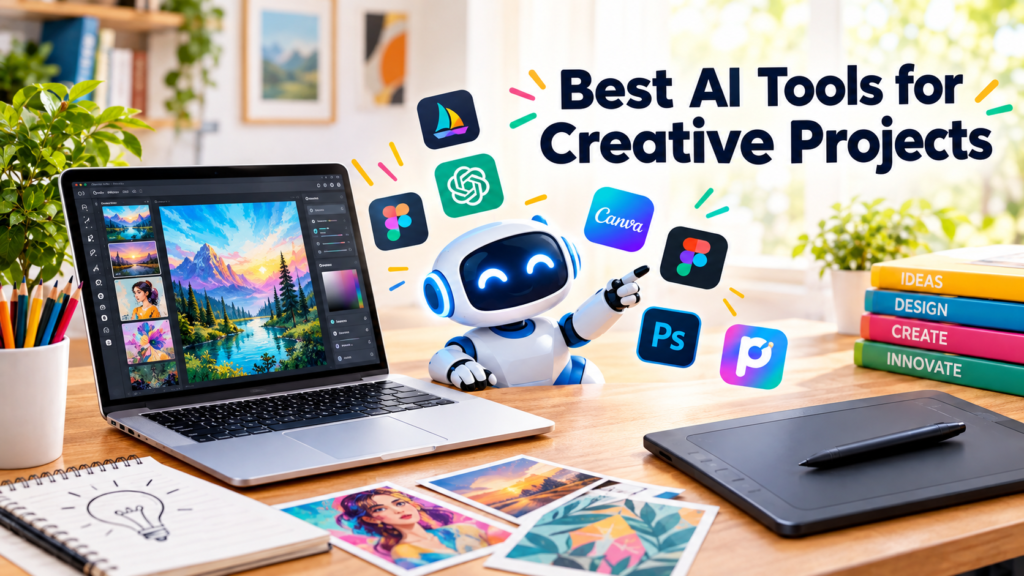
ChatGPT can help with ideas and writing, Canva and Adobe Express can simplify graphic design, Adobe Firefly and Ideogram can help with visual concepts, Figma can support structured design and collaboration, Runway can assist with video projects, and ElevenLabs can be useful for audio work.
From my perspective, the best approach is to use AI as a creative assistant rather than depending on it completely. Start with your own idea, use AI to explore possibilities, and then add your own decisions and improvements.
When used thoughtfully, AI tools can make creative projects faster, easier, and more accessible while still leaving plenty of room for human creativity.