 adsenservice
Related Articles



Studying a large amount of information can become difficult when there are too many definitions, facts, formulas, names, and concepts to remember. I have found that flashcards can make this process much easier because they turn large topics into small questions and answers that are easier to review.
Creating flashcards manually can still take a lot of time, especially when you are studying an entire chapter or preparing for an important exam. This is where prompts can be useful. With a well written prompt, an AI tool can help you turn study material into organized flashcards that focus on the information you actually need to remember.
In my opinion, the most important part is not simply generating a large number of cards. Good flashcards should be clear, focused, and useful for active recall. In this article, I will explain how to create flashcards using prompts and share practical prompt examples that students can use for different subjects and learning goals.
What Are Flashcards?
Flashcards are simple learning tools that usually contain a question or term on one side and the answer or explanation on the other side.
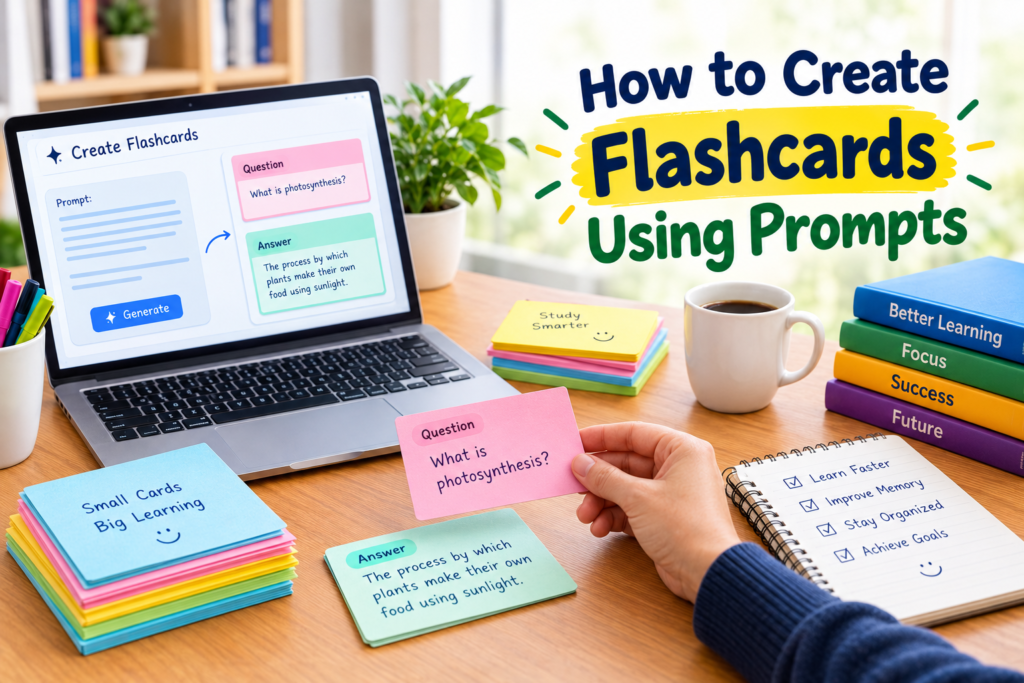
For example, a biology flashcard might ask:
“What is photosynthesis?”
The other side could provide a short explanation of the process.
Flashcards are useful because they encourage you to recall information instead of simply reading it again. You can test yourself, check your answer, and repeat the process until the information becomes easier to remember.
They can be created on paper or with digital flashcard applications.
Why Use Prompts to Create Flashcards?
Creating flashcards manually requires you to read your material, identify important information, write questions, and create answers. Doing this for a large textbook can take hours.
Prompts can speed up this process by giving an AI tool clear instructions about what you want.
For example, instead of asking:
“Make flashcards about biology.”
You can write:
“Create 20 study flashcards about photosynthesis for a beginner biology student. Put one clear question on each card and provide a short, accurate answer. Focus on important concepts, terms, and processes.”
The second prompt provides much more useful information.
Start With Your Study Material
Before creating flashcards, decide what material you want to use.
You might have class notes, a textbook chapter, an article, lecture notes, or your own study guide. The quality of your flashcards depends partly on the quality of the source material.
If you are using AI, provide the relevant text and clearly explain what you want extracted.
A useful prompt is:
“Read the following study material and identify the most important information for revision. Turn the key concepts, definitions, facts, and processes into flashcards. Avoid unnecessary details and repeated information.”
This can help you turn long study material into a more manageable revision resource.
Ask for Clear Questions
A good flashcard should test one main idea. If a question contains several unrelated concepts, it can become difficult to answer.
I recommend asking AI to keep questions specific.
Try this prompt:
“Create flashcards from [TOPIC]. Each card should contain one clear question and one direct answer. Avoid combining multiple concepts into a single question. Keep the questions suitable for active recall.”
For example, instead of asking:
“What are the causes, symptoms, treatments, and prevention methods of this condition?”
It is usually better to create separate cards for each concept.
This makes revision easier because each card tests one specific piece of information.
Keep Answers Short and Useful
The answer on a flashcard should provide enough information to answer the question without becoming a full paragraph.
You can use this prompt:
“Create concise flashcards about [TOPIC]. Keep each answer short enough to review quickly while including the essential information needed to understand the concept.”
If an answer becomes too long, divide it into multiple flashcards.
This is one of the most important parts of creating effective flashcards. A card should help you recall information, not give you another page to read.
Create Definition Flashcards
Definition flashcards are especially useful for subjects that contain many technical terms.
Use this prompt:
“Create 25 definition flashcards from the following study material. Put the term on the front and a simple, accurate definition on the back. Use beginner friendly language and include only important terms.”
For example:
Front: What is evaporation?
Back: The process in which a liquid changes into a gas.
You can use this technique for science, mathematics, history, computer studies, business, and many other subjects.
Create Question and Answer Flashcards
Traditional question and answer flashcards can cover almost any topic.
Try:
“Create 30 question and answer flashcards about [TOPIC]. Cover the most important concepts and facts. Use a mixture of straightforward and slightly challenging questions. Keep answers accurate, concise, and easy to understand.”
This approach gives you a balanced set of cards for general revision.
Create Flashcards From a Long Chapter
If you are studying a long chapter, it can be difficult to know which information deserves attention.
You can ask:
“Read this chapter and create 40 high value flashcards for exam revision. Focus on the main concepts, important definitions, key facts, formulas, processes, and relationships between ideas. Avoid minor details unless they are important for understanding the topic.”
I find this particularly useful when reviewing large chapters before an exam.
However, I still recommend checking the generated cards against your textbook or class notes.
Create Multiple Choice Flashcards
Multiple choice questions can add variety to your study routine.
Use:
“Create 20 multiple choice flashcards about [TOPIC]. Each question should have four answer choices and only one correct answer. Include a short explanation after each answer. Cover different parts of the topic and vary the difficulty.”
These cards can be useful when preparing for exams that use multiple choice questions.
Create Difficult Flashcards
Once you understand the basics, you can create more challenging cards.
Try:
“Create advanced flashcards about [TOPIC] for a student who already understands the basic concepts. Focus on comparisons, applications, causes and effects, problem solving, and common mistakes. Make the questions challenging but clear.”
Advanced flashcards can help you move beyond memorization and test whether you actually understand the subject.
Create Flashcards for Vocabulary
Language learners can also benefit from prompts.
For example:
“Create 30 English vocabulary flashcards for an intermediate learner. Include the word, simple meaning, example sentence, and one common synonym when appropriate.”
You can also request cards for grammar rules, phrases, pronunciation, or difficult words.
This can turn a long vocabulary list into an organized study resource.
Create Mathematics Flashcards
Mathematics flashcards can be slightly different because they often need formulas, rules, and problem solving.
Try:
“Create 20 mathematics flashcards about [TOPIC]. Include important formulas, definitions, rules, and short practice problems. Provide clear solutions for calculation questions.”
For formulas, it can be useful to create one card that asks for the formula and another that asks when the formula should be used.
This tests both memory and understanding.
Create History Flashcards
History often involves dates, people, events, causes, and consequences.
Use:
“Create 30 history flashcards about [TOPIC]. Include important dates, people, events, causes, consequences, and relationships between events. Keep answers concise and suitable for exam revision.”
You can also ask the AI to organize cards chronologically when dates are especially important.
Ask AI to Identify Missing Information
After creating your first flashcard set, you can ask AI to review it.
For example:
“Review these flashcards and identify important concepts that are missing. Suggest additional flashcards without repeating information already included.”
This can help you find gaps in your study material.
Still, I recommend comparing the final set with your syllabus or teacher’s study guide when preparing for an important exam.
Avoid Creating Too Many Flashcards
More flashcards do not always mean better studying.
If you create hundreds of cards from a single chapter, reviewing them can become exhausting. The goal should be to identify the most useful information.
I prefer creating a manageable number of high quality cards and reviewing them regularly.
If a chapter contains 100 small facts, you may not need 100 flashcards. Focus on the information that is important for understanding the subject or likely to be useful during revision.
Review Flashcards Regularly
Creating flashcards is only the first step. You need to use them.
Try reviewing your cards regularly instead of waiting until the night before an exam. Separate cards into categories such as easy, difficult, and needs review.
Cards that you answer correctly several times may require less frequent attention. Cards that you repeatedly get wrong should receive more practice.
You can also use a prompt to organize your revision:
“Create a seven day flashcard review schedule for these cards. Give more frequent review sessions to difficult cards and less frequent sessions to cards I already know well.”
Check AI Generated Flashcards
AI can be helpful, but I would not blindly trust every generated flashcard.
An AI tool may misunderstand your source material or provide an answer that is incomplete. This is especially important for technical subjects, formulas, historical details, and academic topics.
Always compare important information with your trusted study material.
If a card looks confusing or inaccurate, rewrite it rather than memorizing it.
Final Thoughts
Learning how to create flashcards using prompts can make studying faster and more organized. Instead of spending hours manually converting notes into questions and answers, you can use clear prompts to generate a useful starting point.
The best results come from specific instructions. Tell the AI what subject you are studying, who the cards are for, how many cards you need, what information to include, and how detailed the answers should be.
From my point of view, the goal should always be quality rather than quantity. A smaller collection of clear flashcards can be more useful than hundreds of confusing cards.
Use flashcards to test yourself, identify weak areas, and regularly review information. Use prompts to create different types of cards, including definitions, question and answer cards, multiple choice questions, vocabulary cards, formulas, and advanced concept questions.
Most importantly, review every generated card before using it for serious study. When you combine good prompts with your own judgment and regular practice, flashcards can become a simple and powerful part of your study routine.