 adsenservice
Related Articles



Studying a long lesson can sometimes feel overwhelming, especially when the chapter contains many pages, definitions, examples, dates, formulas, or complicated explanations. I have found that trying to remember every single sentence is usually not the best way to study. A much better approach is to understand the lesson and then turn it into a short and simple summary.
Learning how to turn long lessons into simple summaries is a useful skill for students because it makes revision faster and helps important information stay organized. A good summary does not include every detail from the original lesson. Instead, it focuses on the main ideas and the information that is actually important.
In this article, I will explain the practical method I use to simplify long lessons, identify important information, and create summaries that are easier to understand and remember.
Why Simple Summaries Are Useful
Long lessons often contain more information than we need to review at one time. When everything is written in large paragraphs, finding the most important points can become difficult.
A simple summary solves this problem by reducing the lesson to its essential information. Instead of reading ten pages again before an exam, you can review your summary and quickly refresh your memory.
Summaries are also useful because writing them requires you to think about what you are reading. You cannot create a useful summary simply by copying random sentences. You need to understand the lesson and decide which information matters most.
This process can improve both understanding and memory.
Read the Entire Lesson First
One mistake I often see students make is trying to summarize a lesson while reading the first few paragraphs. I prefer to read the lesson once before creating the final summary.
During the first reading, focus on understanding the overall topic. Do not worry about writing perfect notes immediately.
Ask yourself simple questions such as:
What is this lesson mainly about?
What are the most important ideas?
What problem is being explained?
What facts or examples are important?
What should I remember for an exam?
This first reading gives you a general understanding of the lesson. After that, creating a summary becomes much easier.
Identify the Main Topic
Every lesson has a central topic or main idea.
For example, a science lesson might explain photosynthesis. A history lesson might discuss an important historical event. A computer lesson might explain how a particular technology works.
Before writing your summary, try to describe the entire lesson in one sentence.
If you cannot explain the lesson in one simple sentence, you may need to read it again.
For example, instead of writing a long explanation about photosynthesis, your main idea might be:
“Photosynthesis is the process plants use to make food using light energy.”
This sentence gives you a foundation for the rest of your summary.
Break the Lesson Into Sections
A long lesson becomes much easier to understand when you divide it into smaller sections.
Look at the headings and subheadings in the lesson. Each section usually discusses a particular idea.
For example, a lesson about the human digestive system might contain sections about the mouth, stomach, small intestine, large intestine, and digestive enzymes.
Instead of trying to summarize the entire chapter at once, summarize each section separately.
I find this method much less stressful because a large chapter becomes a collection of smaller ideas.
Once each section has been simplified, you can combine the important points into one complete summary.
Find the Key Points
Not every sentence deserves a place in your summary.
When reading each section, look for information that explains the main idea. Pay attention to definitions, important facts, causes, effects, steps, formulas, dates, names, and important examples.
One useful question is:
“If I had to explain this section to someone in two or three sentences, what would I say?”
Your answer will usually contain the key points.
For example, if a lesson contains five paragraphs explaining a process, you may only need to remember the main steps and the purpose of the process.
Remove Repeated Information
Textbooks and lessons sometimes explain the same idea in different ways. This can be helpful when learning a difficult concept, but you do not need to repeat the same information several times in your summary.
Read your notes and look for points that have the same meaning.
If two sentences communicate almost the same idea, combine them into one clear sentence.
This makes the summary shorter without removing important information.
Use Simple Language
When I create a study summary, I try to use language that I would naturally use when explaining something to another person.
You do not need to copy complicated textbook language word for word.
If the original lesson uses a difficult sentence, first understand what it means and then explain the idea in simpler words.
For example, instead of remembering a complicated definition exactly as it appears in a textbook, you can write a simpler explanation beside it.
However, for important technical definitions, formulas, or terms that must be remembered accurately, keep the official terminology and then add your own simple explanation.
This gives you both accuracy and understanding.
Turn Long Paragraphs Into Bullet Points
Bullet points are one of the easiest ways to make long lessons simpler.
Large paragraphs can hide important information. Bullet points make each idea easier to see.
For example:
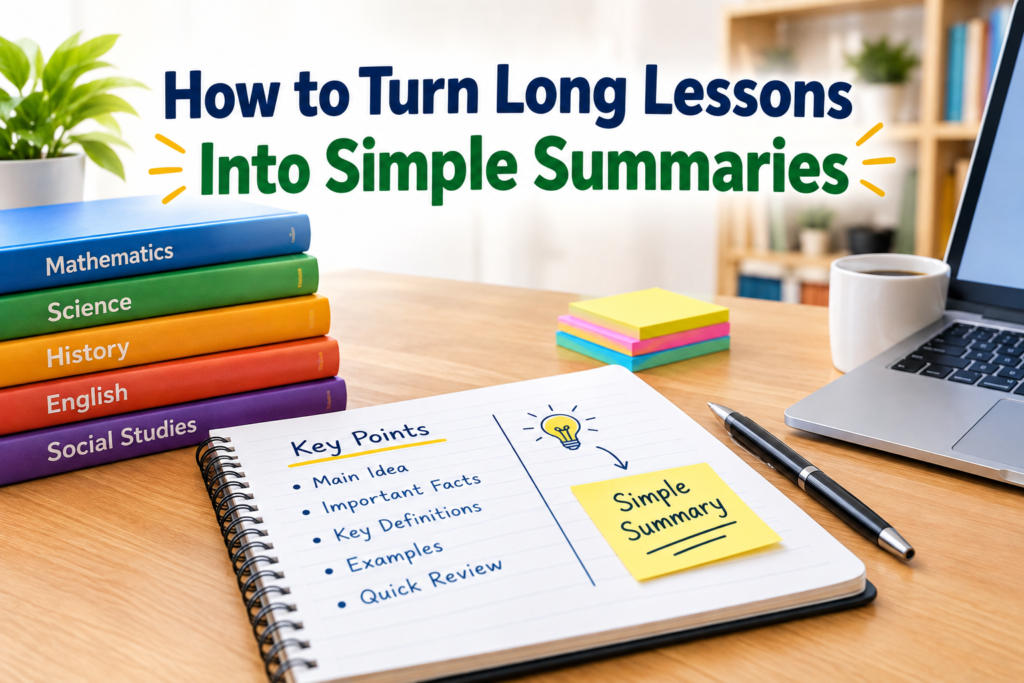
• Main definition
• Important characteristics
• Causes
• Effects
• Examples
• Important facts
This format is especially helpful when reviewing notes before an exam.
You can scan the page quickly and find the information you need without reading several large paragraphs again.
Use Questions and Answers
Another useful technique is turning important parts of a lesson into questions.
Instead of writing:
“Photosynthesis occurs mainly in the leaves of plants.”
You can write:
“Where does photosynthesis mainly occur?”
Answer:
“It mainly occurs in the leaves of plants.”
This method turns passive notes into active study material.
You can create questions about definitions, processes, causes, differences, examples, and important facts.
Later, cover the answers and test yourself.
Create a One Page Summary
Once you have summarized every section, try to reduce the entire lesson to one page if possible.
This does not mean that every lesson must literally fit on one page. The goal is to create a compact version that contains the most important information.
A one page summary might include the main topic, key definitions, important facts, formulas, processes, and a few examples.
This becomes very useful during revision because you can review the entire lesson without going through the original chapter every time.
Use Tables for Comparisons
Some lessons contain information that is easier to understand when it is compared.
For example, if you are studying two scientific processes, historical periods, computer technologies, or economic concepts, a table can organize the differences.
You might create columns for:
Topic
Definition
Main features
Advantages
Disadvantages
Example
A table allows you to compare information quickly and can make revision much easier.
Use Mind Maps for Connected Ideas
Mind maps can be useful when a lesson contains many connected concepts.
Start with the main topic in the center. Then create branches for major sections. From each branch, add smaller points.
For example, a mind map about a business topic might have branches for marketing, finance, customers, products, and competition.
I find mind maps particularly useful when I need to understand how different ideas are connected rather than simply memorizing individual facts.
Highlight Only Important Information
Highlighting can help, but highlighting everything defeats the purpose.
If every sentence is highlighted, nothing stands out.
I recommend highlighting only the most important terms, definitions, dates, formulas, or sentences.
You can also use different symbols in your notes. For example, one symbol can represent an important definition while another can represent something that you need to review later.
The exact system does not matter as much as being consistent.
Use Smart Tools Carefully
Technology can also help when you are learning how to turn long lessons into simple summaries.
Writing and study tools can help identify key points, simplify complicated explanations, organize information, or create questions from notes.
However, I believe students should still read the original lesson themselves. A tool can help organize information, but understanding the subject should come first.
If you use an AI tool, give it clear instructions. For example:
“Summarize this lesson for a beginner. Include the main ideas, important definitions, key facts, and examples. Use simple language and do not remove important technical terms.”
After receiving the summary, compare it with your original lesson to make sure important information has not been missed.
Review Your Summary
Creating a summary is only the first step. You also need to use it.
After finishing your summary, close the book and try to explain the lesson using only your notes.
If you cannot explain an important section, go back to the original material and review it.
You can also review your summary after a day, then again after several days. Regular review can help you remember information for longer.
Common Mistakes to Avoid
One common mistake is copying too much from the original lesson. If your summary is almost as long as the chapter, it is not really simplifying the material.
Another mistake is removing too much information. A summary should be short, but it still needs the important ideas.
Using complicated language is another problem. Your notes should help you understand the subject, not make it more difficult.
Finally, avoid creating a summary without understanding the lesson. The goal is not simply to make fewer words. The goal is to make the information easier to understand and remember.
Final Thoughts
Learning how to turn long lessons into simple summaries can completely change the way you study. Instead of repeatedly reading long chapters, you can break the material into sections, identify the main ideas, remove unnecessary details, and create clear notes.
I believe the most effective summaries are simple, organized, and based on understanding rather than copying. Use headings, bullet points, questions, tables, and mind maps when they make the information easier to remember.
You can also use digital tools to support the process, but your own understanding should always remain at the center.
Once you practice this method regularly, long lessons will feel much more manageable. You will spend less time searching through pages and more time focusing on the information that actually matters.