 adsenservice
Related Articles



Marketing research has always been an important part of building a successful business. Before creating a product, launching a campaign, or writing content, I believe it is important to understand what people actually want. In the past, marketing research could take a lot of time because marketers had to collect information manually, study competitors, analyze customer behavior, and search through large amounts of data.
Today, AI tools for marketing research can make many of these tasks faster and easier. Artificial intelligence can help organize information, identify patterns, generate research ideas, analyze customer feedback, and support market analysis.
However, I do not think AI should completely replace human research. AI is best used as a research assistant. It can help us find useful directions and process information, while we still need to check the facts and make the final decisions ourselves.
In this article, I will explain how to use AI tools for marketing research and how they can help with different parts of the research process.
What Is Marketing Research?
Marketing research is the process of collecting and analyzing information about customers, markets, competitors, products, and industry trends.
For example, if I want to start a website about a particular topic, I first need to understand who might visit that website. I would want to know what people are searching for, what problems they have, what competitors are already offering, and what type of content could provide something useful.
This information can help reduce guesswork.
AI tools can make this process more organized by helping marketers analyze large amounts of information and identify possible patterns.
Why Use AI Tools for Marketing Research?
The biggest advantage I see in using AI for marketing research is saving time.
Research can involve many repetitive tasks. You may need to collect customer comments, organize survey responses, compare competitors, analyze keywords, and summarize reports.
AI can assist with many of these activities.
For example, if I have hundreds of customer comments, an AI tool can help categorize them into common topics such as price, quality, customer service, product features, or delivery.
Instead of reading every comment and manually creating categories, I can use AI to create an initial summary and then review the results.
This does not remove the need for human judgment. It simply makes the first stage of analysis faster.
Start With a Clear Research Question
Before using any AI marketing research tool, I recommend deciding exactly what you want to learn.
This is one of the most important steps because AI can provide a huge amount of information. Without a clear question, the research can quickly become confusing.
For example, instead of asking, “Tell me about digital marketing,” I could ask, “What problems do small businesses commonly face when creating social media content?”
The second question is more specific.
A clear research question helps AI provide more focused ideas and makes it easier to decide whether the information is useful.
Use AI for Market Research Ideas
One of the easiest ways to use AI for marketing research is brainstorming.
I can provide information about my business, target audience, product, or industry and ask an AI tool to suggest research questions.
For example, if I run an online clothing store, I could ask AI to suggest questions about customer preferences, shopping behavior, pricing concerns, popular styles, and purchasing decisions.
These suggestions can help me think about areas that I might not have considered.
I would then select the useful questions and conduct further research using real data and reliable sources.
Analyze Your Target Audience
Understanding the target audience is essential for effective marketing.
AI tools can help organize information about customer interests, common questions, problems, and preferences.
For example, marketers can analyze customer reviews, survey responses, support messages, and social media comments to identify frequently discussed topics.
If many customers mention the same problem, that can be an important insight.
AI can help group similar comments together and summarize recurring themes. This can make audience research easier, especially when there is a large amount of text to review.
Still, I would always check the original feedback because summaries can sometimes miss context.
Use AI for Competitor Research
Competitor analysis is another area where AI can be useful.
Before launching a product or content strategy, I like to understand what competitors are already doing. This can include looking at their websites, content topics, product features, social media activity, and customer feedback.
AI can help organize competitor information into categories.
For example, I can create a simple comparison that looks at pricing, features, content topics, customer concerns, and marketing channels.
The purpose should not be to copy competitors. Instead, competitor research can help identify what customers are already being offered and where there may be opportunities to provide something different.
Perform Keyword Research With AI
Keywords are important for search marketing and content planning.
AI tools can help generate keyword ideas based on a topic. They can also help organize keywords into categories based on search intent.
For example, someone searching for “best running shoes” may be looking for product recommendations, while someone searching for “how to clean running shoes” may be looking for instructions.
Understanding this difference can help create more relevant content.
I would use AI to generate ideas, but I would also verify keywords using dedicated SEO and keyword research tools. Search volume, competition, trends, and actual search results can provide information that a general AI tool may not have.
Find Content Opportunities
AI can also help turn marketing research into content ideas.
After collecting customer questions and competitor information, I can ask an AI tool to identify topics that could be useful to my audience.
For example, if customers frequently ask how to choose between two types of products, that question could become a comparison article.
If customers repeatedly ask how to solve a particular problem, it could become a detailed tutorial.
This is one of my favorite ways to use AI for marketing research because it connects research directly with content creation.
Instead of creating random blog posts, I can focus on questions that real customers are asking.
Analyze Customer Reviews
Customer reviews contain valuable marketing research information.
Positive reviews can show what customers appreciate, while negative reviews can reveal problems that need attention.
AI can help analyze large collections of reviews and identify common themes.
For example, an online store could analyze hundreds of reviews and discover that customers frequently praise product quality but complain about packaging.
That information can help the business understand where improvements may be needed.
AI should not be trusted to interpret every review perfectly, though. Sarcasm, context, and unusual language can sometimes confuse automated systems. Human review is still important.
Use AI to Analyze Surveys
Surveys can generate a lot of useful information, but analyzing responses manually can take time.
AI can help summarize open ended survey responses and group answers into common themes.
For example, a business could ask customers why they chose a particular product. AI could help organize responses into categories such as price, convenience, quality, recommendations, features, and brand reputation.
This can give marketers a quick overview of customer opinions.
For numerical survey data, traditional analytics tools can still be extremely useful. AI should be considered an additional research tool rather than the only method of analysis.
Research Market Trends
Market trends can change quickly.
AI tools can help marketers organize information about changing customer interests, popular topics, emerging products, and industry developments.
However, this is an area where I would be especially careful.
AI can provide information based on the data available to it, but current trends should be verified through recent and reliable sources.
Search trends, industry reports, official statistics, reputable publications, and current market data can provide stronger evidence.
AI can then help summarize and organize that information.
Ask Better Questions to Get Better Results
The quality of AI research depends heavily on the instructions provided to the tool.
A vague prompt often produces a generic answer.
Instead of asking, “Give me marketing research,” I would provide context.
For example, I might explain the type of business, target customer, location, product category, research goal, and specific questions I want answered.
I can also ask the AI to organize the response into tables, categories, questions, or research areas.
The more clearly I explain the research objective, the more useful the output usually becomes.
Always Verify AI Generated Research
This is probably the most important point in this entire article.
AI can make mistakes.
It may misunderstand information, provide outdated details, or present an unsupported statement with confidence.
That is why I never consider an AI response to be the final research report.
If AI provides a statistic, market size, customer trend, company detail, or other important claim, I verify it through a reliable source.
This is especially important when research will influence business investments, pricing, advertising budgets, or major product decisions.
AI can speed up research, but accuracy should remain the priority.
Combine AI With Human Research
I believe the best marketing research process combines AI tools with traditional research methods.
AI can help brainstorm questions, organize information, summarize text, identify themes, and generate research directions.
Human research can provide direct customer feedback, interviews, surveys, observation, official data, and real market experience.
Combining these methods gives a more complete picture.
For example, AI might identify that customers frequently complain about complicated product instructions. I could then speak directly with customers to understand why they feel that way.
The AI helps identify the area, while human research provides deeper context.
Common Mistakes to Avoid
One common mistake is trusting AI without verification.
Another mistake is using AI without a clear research objective. This can result in large amounts of information that are difficult to use.
I would also avoid copying competitor content simply because an AI tool identifies it as successful.
Research should help you understand the market, not encourage you to duplicate someone else’s strategy.
Finally, I would avoid putting sensitive customer information into AI tools without understanding the tool’s privacy and data handling practices.
Final Thoughts
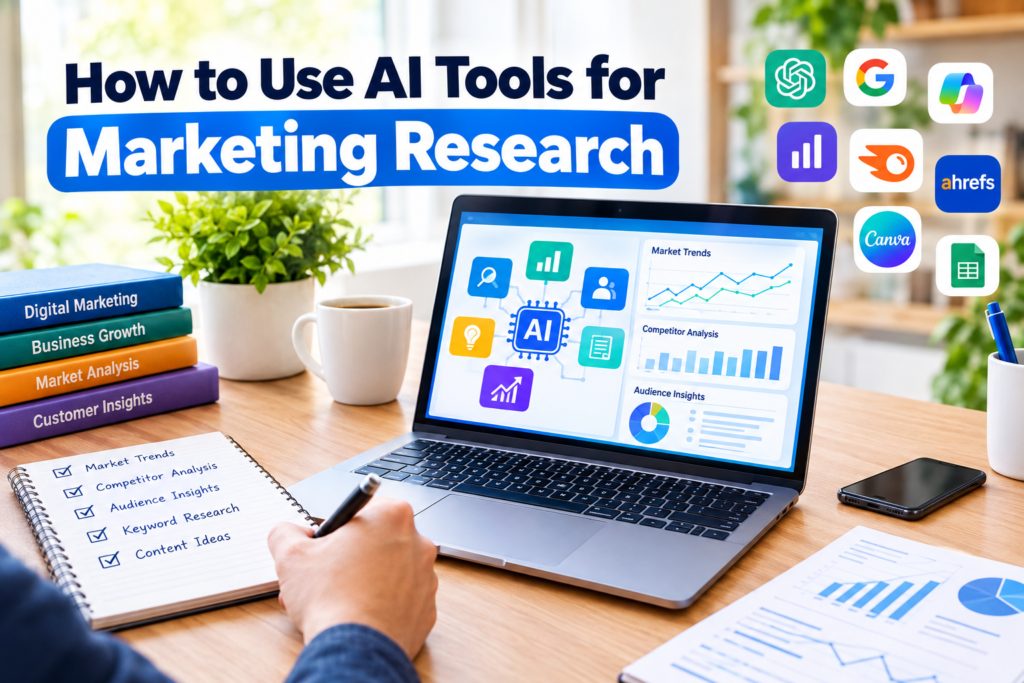
AI tools for marketing research can make the research process faster, more organized, and easier to manage. They can help with audience research, competitor analysis, keyword research, customer feedback, surveys, market trends, and content planning.
In my opinion, the best approach is to treat AI as a research assistant rather than a replacement for real research.
I can use AI to generate ideas and organize information, but I still need to verify important facts and understand the context behind the data.
Marketing is ultimately about understanding people. AI can help us process information, but real customer needs, experiences, and feedback should remain at the center of the research process.
When AI tools are combined with human judgment and reliable data, they can become a valuable part of a modern marketing research workflow.