 adsenservice
Related Articles



Creating good marketing content takes time, creativity, research, and consistency. Whether I am writing a blog post, preparing a social media caption, creating an email campaign, or planning an advertisement, there are usually many small tasks involved. This is where AI tools for marketing content can make the process much easier.
I have found that artificial intelligence is most useful when it works as a helping hand rather than replacing the person behind the content. AI can help generate ideas, organize information, improve writing, create visuals, and speed up repetitive marketing tasks. However, I still believe that human experience and judgment are important when creating content that people actually want to read.
In this article, I will discuss some of the best AI tools for marketing content and explain how they can be useful for bloggers, marketers, business owners, and content creators.
Why Use AI Tools for Marketing Content?
Marketing requires a constant supply of fresh content. A business may need blog articles, social media posts, product descriptions, newsletters, advertisements, videos, and graphics every week.
Doing everything manually can take a considerable amount of time. AI marketing tools can reduce the workload by helping with different stages of the content creation process.
For example, I can use an AI writing tool to brainstorm topics, create an initial outline, improve a paragraph, or suggest different headlines. Instead of spending a long time starting from a blank page, I can begin with ideas and then add my own knowledge and experience.
The real benefit is not simply producing more content. The bigger benefit is saving time so that more attention can be given to quality and strategy.
ChatGPT for Marketing Content
ChatGPT is one of the most flexible AI tools for marketing content. It can help with brainstorming, content outlines, blog ideas, social media captions, email drafts, product descriptions, FAQs, and many other marketing tasks.
What I like most about a general purpose AI tool is its flexibility. I can give it a topic and explain the audience, tone, word count, and purpose of the content. It can then provide a starting point that I can review and improve.
For example, if I am preparing a blog about a new product, I can ask for different content angles and headline ideas. I can then choose the ideas that fit my audience.
I would not recommend publishing AI generated content without reviewing it. Personal experience, accurate information, examples, and a natural writing style can make the final content much more valuable.
Jasper for Marketing Teams
Jasper is designed with marketing and business content in mind. It can be useful for marketers who regularly create campaigns and need consistent messaging across different channels.
A marketing team may use an AI tool like Jasper for advertising copy, blog content, email marketing, social media content, and campaign ideas.
One useful aspect of marketing focused AI software is the ability to work with brand related content and maintain a consistent tone.
For businesses with multiple people creating content, consistency can be important. The brand should sound recognizable whether someone is reading a website page, advertisement, or social media post.
Canva for AI Content Creation
Canva is particularly useful when marketing content needs attractive visuals. Marketing is not only about written words. Images, presentations, social media graphics, advertisements, and other visual materials can have an important role.
Canva provides design tools along with AI powered features that can help users create and edit visual content more efficiently.
I find tools like Canva useful when I need to turn an idea into a social media graphic without spending hours working with complicated design software.
A simple workflow can be to create the written message first and then design a visual around the main idea. This helps keep the image and text connected.
Grammarly for Content Improvement
Writing marketing content is not only about generating words. Editing is equally important.
Grammarly can help review writing for grammar, spelling, clarity, tone, and other aspects of communication. This can be useful when preparing website content, emails, advertisements, or social media posts.
Even when I write something myself, I can make small grammar mistakes or create sentences that are harder to understand than necessary. A writing assistant can help identify these issues.
However, I believe suggestions should always be reviewed before accepting them. Good editing requires understanding the context and intended meaning.
Google Ads and AI Marketing Features
Advertising platforms are also using AI to help marketers create and optimize campaigns.
Google Ads provides AI powered features that can assist with different parts of advertising, including campaign creation and optimization.
For someone managing online advertising, these features can reduce some repetitive work. However, marketers still need to understand their audience, advertising goals, budget, and business objectives.
AI can help process information and automate tasks, but marketing decisions should still be based on real business data and customer needs.
HubSpot AI Tools
HubSpot provides marketing, sales, and customer management software with AI features that can assist with content creation and other marketing activities.
This can be useful for businesses that want several marketing functions connected within one platform.
AI features can help with tasks such as writing content, brainstorming ideas, summarizing information, and supporting marketing workflows.
For larger marketing operations, having content creation connected with customer and campaign data can make the overall workflow more organized.
Surfer SEO for Content Optimization
Creating an article is only one part of content marketing. Getting that article in front of the right audience is another challenge.
SEO tools can help marketers understand topics, keywords, content structure, and search optimization opportunities.
Surfer SEO is one tool that focuses on content optimization. It can help writers review content and identify areas that may need improvement for search visibility.
I think SEO tools are most useful when they support good writing rather than control it completely. Keywords should fit naturally into the article, and the content should answer the reader’s question first.
Copy.ai for Marketing Copy
Copy.ai focuses on helping businesses create marketing and sales content. It can be useful for tasks such as advertisements, email content, social media posts, website copy, and product messaging.
Marketing copy often requires several variations of the same message. For example, an advertiser may want different headlines or descriptions for different audiences.
AI can make this process faster by generating multiple starting points. I can then select an idea and adjust it to match the brand and audience.
This approach can be more useful than expecting an AI tool to produce a perfect final advertisement with one prompt.
AI Tools for Social Media Marketing
Social media marketers have to create content regularly. AI tools can help generate caption ideas, content calendars, post variations, and creative concepts.
The important thing is maintaining a genuine connection with the audience. Social media content that feels completely automated may not create the same connection as content that reflects real experience.
I prefer using AI to handle brainstorming and repetitive work while keeping the final message personal.
For example, AI might suggest ten caption ideas, but I can select one and rewrite it using my own voice.
AI Tools for Email Marketing
Email marketing is another area where AI can save time. Marketers can use AI to brainstorm subject lines, draft email messages, create different versions of an offer, and improve clarity.
A good email should have a clear purpose. The reader should understand why they received the message and what action they can take.
AI can provide several versions quickly, but the marketer should check every claim, link, offer, and detail before sending the email.
How to Choose the Right AI Marketing Tool
There is no single AI marketing tool that is perfect for every person.
Before choosing a tool, I would first identify the actual problem I want to solve.
If I mainly need writing assistance, an AI writing platform may be enough. If I need graphics, a design platform may be more useful. If SEO is my main concern, an SEO content tool could provide more relevant features.
I would also look at pricing, ease of use, available features, integrations, privacy options, and the type of content the tool is designed to create.
Free tools can be a good starting point, especially for beginners. However, paid plans may provide additional features for people who create content regularly.
Do AI Tools Replace Marketing Writers?
I do not think marketing is simply about producing sentences.
A good marketer needs to understand customers, identify problems, communicate benefits, create a strategy, and understand what makes an audience respond.
AI can assist with many production tasks, but human creativity and judgment still have an important role.
I see AI as a productivity tool. A marketer who knows how to use AI effectively can spend less time on repetitive tasks and more time thinking about strategy and the audience.
Best Way to Use AI for Marketing Content
In my experience, the best workflow is to combine AI assistance with human editing.
First, I define the goal of the content. Then I research the topic and identify the audience. After that, I can use AI to brainstorm ideas or create an initial structure.
Once the draft is ready, I review it carefully. I check facts, remove unnecessary information, add examples, improve the tone, and make sure the content sounds natural.
This final editing stage is very important. AI can create a useful starting point, but the finished content should reflect the business, brand, and audience.
Final Thoughts
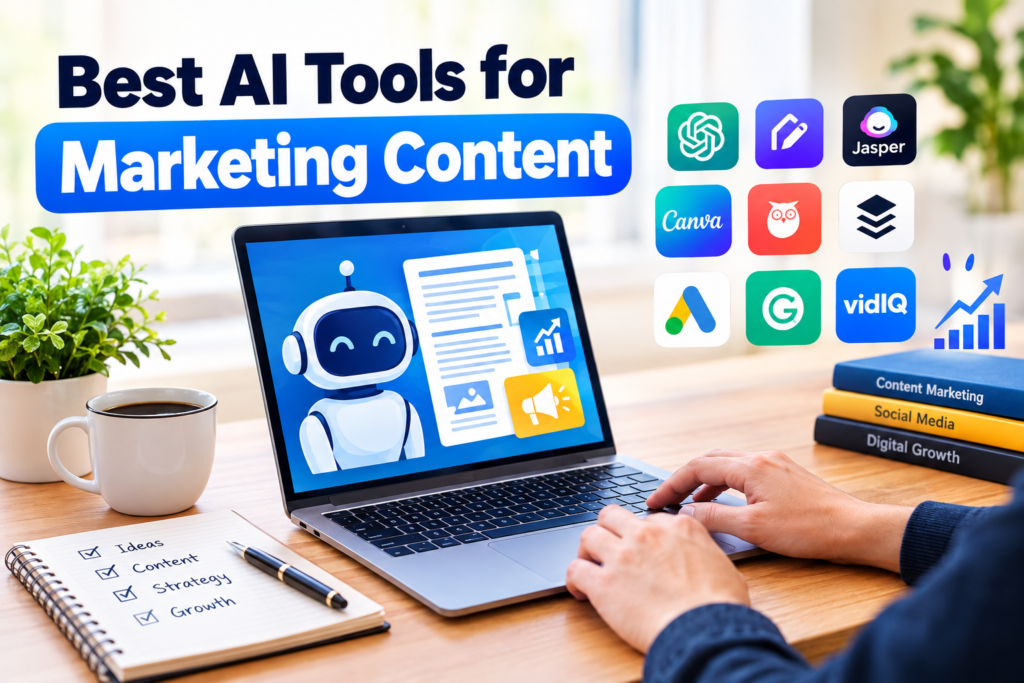
The best AI tools for marketing content can make content creation faster and more organized. Tools such as ChatGPT, Jasper, Canva, Grammarly, HubSpot, Copy.ai, and SEO platforms can help marketers with different parts of the content process.
However, I believe the tool itself is only one part of successful content marketing. Good results also depend on strategy, research, creativity, accuracy, and understanding the audience.
For me, the smartest way to use AI is not to let it do everything. I use it to reduce repetitive work, generate ideas, improve drafts, and explore possibilities. Then I bring my own knowledge and judgment into the final content.
That combination can make marketing content more useful, consistent, and engaging while allowing creators to spend more time on the things that AI cannot replace easily: understanding people and creating meaningful communication.