 adsenservice
Related Articles



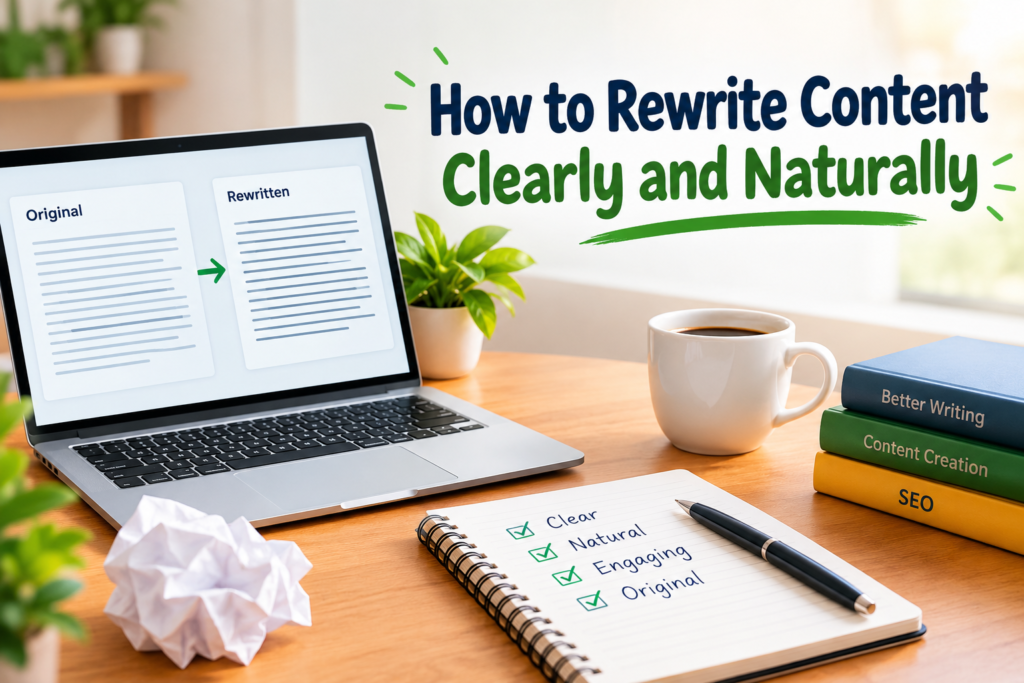
When I rewrite content, my main goal is not simply to replace words with synonyms. Good rewriting is about making the original idea easier to understand while keeping the meaning accurate and making the writing sound natural. A well rewritten article should feel like it was written naturally from the beginning, not like someone changed a few words from another piece of content.
Whether you are rewriting a blog post, website copy, product description, email, or informational article, clarity should always come first. Natural writing is easier to read, more engaging, and more useful for the audience.
In this guide, I will explain how to rewrite content clearly and naturally, what mistakes to avoid, and how to improve rewritten content without losing the original message.
Understand the Original Content First
Before rewriting anything, I believe it is important to understand the original content completely. If you start changing sentences without understanding the main idea, it becomes easy to change the meaning accidentally.
Read the original content carefully and identify its main purpose. Ask yourself what the writer is trying to explain, who the intended audience is, and what information must remain unchanged.
For example, if the original paragraph explains how to improve website speed, the rewritten version should still focus on website speed. You can change the structure and wording, but the central information should remain accurate.
I usually focus on the meaning before focusing on individual words. This makes the rewriting process much more effective.
Rewrite Ideas Instead of Individual Words
One of the most common rewriting mistakes is changing every word into a synonym. This can make the content sound unnatural and sometimes confusing.
For example, a sentence such as “Regular exercise provides numerous benefits for overall health” does not need to become something complicated like “Consistent physical activity delivers countless advantages for general wellness.”
The second sentence uses different words, but it does not necessarily communicate the idea better.
A more natural version could be “Regular exercise can improve your overall health and help you feel better.”
This approach makes the content easier to read while keeping the original idea.
Use Simple and Clear Language
Clear content does not need complicated vocabulary. In my experience, simple language usually works better because readers can understand the message quickly.
Instead of using unnecessarily complex words, choose familiar words whenever possible. This is especially important for blog posts and informational websites where the goal is to help readers.
For example, instead of saying:
“Utilizing appropriate strategies can facilitate the enhancement of writing quality.”
You can write:
“Using the right strategies can improve your writing.”
The second version is shorter, clearer, and more natural.
When rewriting content, I always look for sentences that sound too formal or complicated and simplify them without removing important information.
Change the Sentence Structure
Another useful technique is changing the structure of sentences. You do not have to follow the same order as the original content.
If the original text contains several long sentences, consider breaking them into shorter sentences. If several ideas are presented separately, you can sometimes combine them when doing so improves the flow.
For example:
“Many people experience problems with slow internet connections, and these problems can occur because of several different factors.”
This can become:
“Slow internet can happen for several reasons. Many people experience this problem without knowing what is causing it.”
The meaning remains similar, but the rewritten version is easier to follow.
Changing sentence structure also helps make rewritten content feel more original and natural.
Keep the Reader in Mind
Good rewriting is not only about the words on the page. It is also about the person reading them.
Think about what your audience already knows and what they need to understand. A technical audience may be comfortable with industry terms, while beginners may need simple explanations.
For a beginner focused article, I would avoid assuming that the reader already understands complicated concepts. Instead, I would explain the topic step by step.
This makes the content more useful and creates a better reading experience.
Improve the Introduction
The introduction is one of the most important parts of any article. When rewriting content, I do not always keep the original introduction structure.
A strong introduction should quickly tell readers what the topic is and why it matters. It should also encourage them to continue reading.
For example, if you are rewriting an article about content writing, you can begin by explaining a common problem writers face.
“Writing regularly is not always the hardest part of content creation. Sometimes the bigger challenge is making your writing clear, useful, and natural.”
This type of opening immediately introduces a relatable issue.
Remove Unnecessary Repetition
Repeated information can make content feel longer without making it more useful. During the rewriting process, look for sentences that communicate the same idea more than once.
If two paragraphs make almost identical points, consider combining them.
This is particularly important for SEO content because longer articles should not simply contain more words. They should provide more useful information.
Every paragraph should have a purpose. If a sentence does not add information, explanation, context, or value, consider removing it.
Use Active Voice When Appropriate
Active voice can make writing clearer and more direct.
For example:
“The article was written by the content writer.”
can become:
“The content writer wrote the article.”
The second sentence is more direct.
Passive voice is not always wrong, and there are situations where it is useful. However, when rewriting general web content, active voice can often make sentences easier to understand.
I recommend checking long passive sentences and deciding whether an active version would sound more natural.
Add Natural Transitions
Good transitions help readers move smoothly from one idea to another.
Words and phrases such as “for example,” “however,” “in addition,” “another useful step,” and “as a result” can connect ideas when they are used naturally.
The important point is not to add transition words to every sentence. Too many can make writing feel artificial.
Instead, use them where the relationship between two ideas needs to be clearer.
Keep the Original Meaning Accurate
A rewritten article should not introduce incorrect information. This is especially important when rewriting technical, financial, educational, or instructional content.
Before finishing, compare the rewritten version with the source and check the important facts, instructions, numbers, and claims.
Ask yourself whether anything important was accidentally removed or changed.
A good rewrite improves the presentation while protecting the accuracy of the original message.
Make the Content Sound Human
Natural writing usually has variation. Sentences are not all the same length, paragraphs are not identical, and the writer does not repeat the same expressions constantly.
When rewriting content, try to create a conversational but professional tone.
You can use direct explanations, examples, questions, and practical observations where appropriate.
For example, instead of writing:
“It is important for individuals to ensure that they regularly review their content.”
A more natural version would be:
“I recommend reviewing your content before publishing it. A quick review can help you catch unclear sentences and unnecessary repetition.”
This sounds more personal and useful.
Avoid Keyword Stuffing
If you are rewriting content for SEO, keywords are important, but they should not control every sentence.
The primary keyword should appear naturally in the title, introduction, headings, and relevant parts of the article. Related terms can also help search engines understand the subject.
For this topic, relevant phrases may include “rewrite content,” “rewrite content clearly,” “natural content writing,” “content rewriting,” and “how to rewrite content.”
However, repeating the same keyword too many times can make an article difficult to read.
My approach is to write for people first and optimize the content naturally afterward.
Use Headings to Organize Information
Headings make long articles easier to scan. When rewriting a detailed article, consider whether the existing headings actually help the reader.
A useful heading should clearly tell the reader what the following section is about.
For example, headings such as “Understand the Original Content,” “Use Simple Language,” and “Improve the Introduction” are straightforward and descriptive.
This structure is helpful for readers and can also support SEO by making the topic and subtopics easier to understand.
Read the Rewritten Content Out Loud
One of the simplest ways to find unnatural writing is to read it out loud.
When you read silently, your brain may automatically ignore awkward phrases. Reading aloud makes those problems easier to notice.
Listen for sentences that feel too long, repeated words, unusual expressions, and places where you naturally want to pause.
If a sentence sounds like something you would never say in a normal conversation, consider rewriting it.
This small step can make a noticeable difference in the final quality.
Use Writing Tools Carefully
Grammar and writing tools can help identify spelling mistakes, grammar problems, punctuation issues, and unclear sentences. They can be useful during the editing stage.
However, I would not depend completely on automated suggestions.
A writing tool may recommend a technically correct change that does not fit the intended tone or audience. Always review suggestions yourself.
The final decision should be based on meaning, readability, and context.
Check the Content After Rewriting
After completing the rewrite, take a short break if possible and then review the article again.
I recommend checking several things.
First, make sure the main message is still accurate. Second, look for awkward sentences and unnecessary repetition. Third, check headings and paragraph structure. Finally, review spelling, grammar, punctuation, and keyword placement.
It is also useful to compare the rewritten article with the original one to make sure important details were not accidentally removed.
Focus on Value, Not Just Difference
A rewritten article should be different in wording and structure, but being different is not the only goal.
The rewritten version should ideally be clearer, easier to read, and more useful than the original.
This is why I prefer to think of content rewriting as an editing and improvement process rather than a simple word replacement task.
If the original content has a confusing explanation, improve it. If a paragraph is too long, break it up. If an example would help the reader, add one when appropriate.
That is what makes rewriting genuinely valuable.
Final Thoughts
Learning how to rewrite content clearly and naturally takes practice. The best results come from understanding the original message first and then rebuilding the content in a way that feels simple, useful, and natural.
Avoid replacing words mechanically. Focus on ideas, sentence structure, readability, accuracy, and the needs of your audience. Use simple language, remove repetition, improve weak sections, and review the finished article carefully.
For SEO content, include keywords naturally rather than forcing them into every paragraph. Most importantly, remember that search engines may help people discover your content, but real people are the ones who read it.
In my view, the strongest rewritten content is content that no longer feels like a rewrite. It feels clear, helpful, original in expression, and natural from the first sentence to the last.