 adsenservice
Related Articles



Coming up with fresh content ideas can sometimes be harder than writing the actual content. I have faced this problem many times. You may have a good website, a clear niche, and enough knowledge, but suddenly you sit down to write and cannot think of a topic that feels useful and interesting.
This is where prompts can make the process much easier. A well written prompt can help you explore different angles, understand your audience, discover questions, and turn simple thoughts into useful content ideas. In my experience, the key is not simply asking an AI tool to give you ideas. The quality of the prompt has a major effect on the quality of the results.
In this guide, I will explain how to create better content ideas with prompts and how you can use simple prompting techniques to build a reliable content idea process.
Why Content Ideas Matter
Good content starts with a good idea. Even excellent writing may struggle if the topic does not solve a real problem or answer a question people care about.
Content ideas are important for blogs, websites, newsletters, social media pages, YouTube channels, and online businesses. When you have a strong list of ideas, you do not have to spend hours wondering what to publish next.
I believe useful content usually starts with understanding three things. You need to know what your audience wants, what problems they are facing, and what information you can provide from your own knowledge or research.
Prompts can help organize these thoughts and turn them into practical topic ideas.
What Is a Content Prompt?
A content prompt is an instruction that tells an AI tool what type of ideas you want. A basic prompt might be something like, “Give me blog ideas about gardening.”
This can produce ideas, but the results may be quite general.
A stronger prompt gives more context. For example, you could ask for beginner friendly gardening topics aimed at people living in small apartments. You can also mention the content format, search intent, audience concerns, and your preferred writing style.
The more useful information you provide, the easier it becomes to receive relevant content ideas.
Start With Your Main Topic
Before creating prompts, I recommend defining your main topic or niche. This gives your content planning a clear direction.
For example, your main topic could be:
Home gardening
Freelancing
Technology
Personal finance
Cooking
Fitness
Travel
Digital marketing
Once you choose the main topic, you can use prompts to explore smaller subjects within it.
For example, instead of asking for general gardening ideas, ask for content ideas about growing vegetables in containers for beginners. This creates a much more focused starting point.
Tell the Prompt Who Your Audience Is
One of the simplest ways to improve content ideas is to describe your target audience.
Think about who will read your content. Are they beginners, experienced users, students, parents, freelancers, business owners, or hobbyists?
For example, instead of writing:
“Give me content ideas about freelancing.”
You could write:
“Give me 20 beginner friendly blog post ideas about freelancing for people who want to find their first online client.”
This gives the AI a clear audience and purpose.
I find audience focused prompts much more useful because they encourage ideas based on real questions and problems rather than random topics.
Ask for Problems and Questions
Another useful prompting technique is to focus on problems.
People often search for content because they want help with something. Therefore, asking for common problems can produce excellent content ideas.
You can use a prompt such as:
“List 30 common problems beginners face when starting a vegetable container garden. Turn each problem into a practical blog topic.”
This approach can generate ideas that are naturally useful.
You can also ask for frequently asked questions. Questions can become blog posts, FAQ sections, social media posts, videos, or email content.
Use Different Content Angles
Sometimes you have already covered the obvious topics in your niche. Instead of changing your entire subject, try changing the angle.
For example, if your main topic is WiFi, you could create content around:
Common mistakes
Beginner guides
Troubleshooting
Security
Speed improvement
Equipment selection
Privacy
Step by step tutorials
Questions and answers
This method helps you discover more content ideas without moving away from your main niche.
A useful prompt could be:
“Give me 25 different content angles for the topic WiFi security. Include beginner guides, troubleshooting topics, common mistakes, practical tips, and frequently asked questions.”
Ask for Long Tail Content Ideas
Long tail topics can be useful because they focus on specific questions and problems.
Instead of creating a broad topic such as “Freelancing Tips,” you could explore topics like “How to Handle Client Feedback as a New Freelancer.”
A prompt can help you discover these specific subjects.
Try:
“Generate 30 long tail blog post ideas about freelancing for beginners. Focus on specific questions, problems, and practical solutions.”
This can give you a large list of focused topics to research and develop.
Include Search Intent in Your Prompts
Search intent is another important part of content planning. People search for information for different reasons.
Some want to learn something. Others want to solve a problem, compare options, find a product, or complete a task.
When creating prompts, tell the AI what type of search intent you want.
For example:
“Create 20 informational blog ideas about Windows troubleshooting. Focus on topics where readers want step by step solutions to common problems.”
This can make the resulting ideas more suitable for helpful SEO content.
Ask for Content Clusters
If you want to build a larger website, content clusters can make planning easier.
A content cluster consists of a main topic supported by several related articles.
For example, a main topic could be “Container Vegetable Gardening.” Supporting articles might cover pot size, drainage, watering, sunlight, soil, vegetables for beginners, and common mistakes.
You can ask:
“Create a content cluster around container vegetable gardening. Give me one main topic and 20 related supporting blog topics. Make sure every topic addresses a different reader question.”
This approach can help you create an organized publishing plan.
Turn One Idea Into Many Ideas
You do not always need completely new subjects. One good topic can be expanded into several useful pieces of content.
Suppose you have an article called “How to Improve WiFi Speed.”
You could create related topics about router placement, network congestion, outdated hardware, signal interference, device settings, and common troubleshooting steps.
A useful prompt is:
“Take this content idea and create 15 related blog topics that explore different problems, questions, beginner concerns, and practical solutions.”
This is one of my favorite ways to save time because a single useful idea can become the starting point for an entire content series.
Ask for Different Formats
Content ideas do not have to be limited to blog posts.
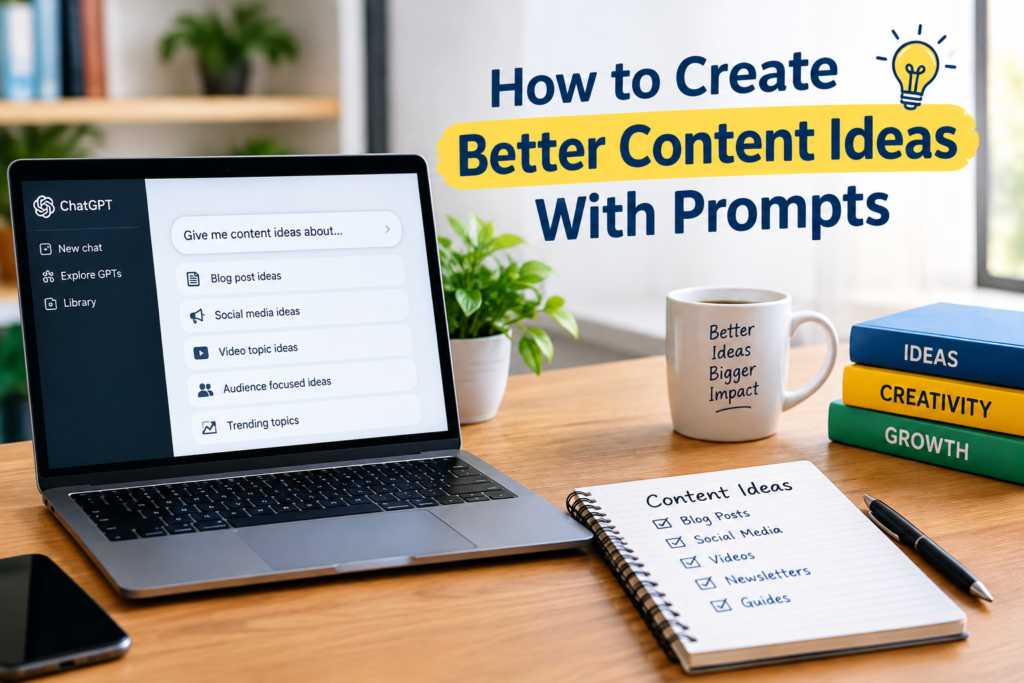
You can ask prompts to generate ideas for videos, social media posts, newsletters, guides, tutorials, checklists, and FAQs.
For example:
“Take the topic ‘How to Protect Personal Information Online’ and create ideas for five blog posts, five short videos, five social media posts, and five email newsletter topics.”
This allows you to reuse your knowledge across different platforms while keeping the content focused.
Improve Weak Prompts
If your first results are too generic, do not immediately assume the AI tool is not useful. Look at your prompt.
A weak prompt might say:
“Give me technology blog ideas.”
A better version could say:
“Give me 30 SEO focused blog ideas about everyday technology problems for beginners. Focus on practical problems involving Windows computers, Android phones, WiFi, apps, storage, and browser issues. Make each topic specific and useful.”
The second prompt provides much more direction.
This is an important lesson I have learned about using AI for content creation. Better instructions usually lead to better brainstorming.
Ask for Unique Angles
Another useful technique is asking for ideas that avoid repetitive topics.
Try a prompt such as:
“Give me 20 content ideas about freelancing that avoid basic topics such as how to create a profile or how to find clients. Focus on overlooked problems and practical situations freelancers experience.”
This can help you move beyond the same common topics that appear on many websites.
You can also ask for beginner, intermediate, and advanced ideas separately. This creates a more balanced content strategy.
Always Review AI Generated Ideas
Prompts can make brainstorming faster, but I would not publish every idea exactly as it is generated.
Review each topic and ask yourself whether it is genuinely useful. Check whether it fits your website, audience, and expertise. You should also research important facts before publishing.
I prefer using AI as a brainstorming assistant rather than treating it as a replacement for my own knowledge.
Your personal experience can make an ordinary topic much more valuable. Add examples, practical observations, lessons you have learned, and clear explanations.
Create a Reusable Master Prompt
Once you find a prompt structure that works well, save it and reuse it.
For example, your master prompt can include your niche, target audience, content type, search intent, desired number of ideas, and topics you want to avoid.
You can then change only the main subject whenever you need new ideas.
This saves time and gives your content planning a consistent structure.
Final Thoughts
Learning how to create better content ideas with prompts can make content planning much easier. The biggest improvement usually comes from giving clear instructions instead of asking vague questions.
Start with your niche, define your audience, identify their problems, and explain the type of content you want. Then experiment with different angles, long tail topics, search intent, content clusters, and formats.
From my point of view, the best content ideas are not necessarily the most complicated ones. A simple topic that answers a real question can be more useful than a broad topic filled with unnecessary information.
Use prompts to expand your thinking, but bring your own knowledge and experience into the final content. That combination can help you create useful, original, and audience focused content consistently.