 adsenservice
Related Articles


Research can be one of the most time consuming parts of studying, writing, blogging, and professional work. I often find that the real challenge is not finding information. The challenge is going through a large amount of information and identifying what actually matters.
A single research paper can contain dozens of pages. A detailed report can take hours to read carefully. Even a long article may contain information that is useful but difficult to organize quickly.
This is where AI tools for summarizing research material can be extremely helpful.
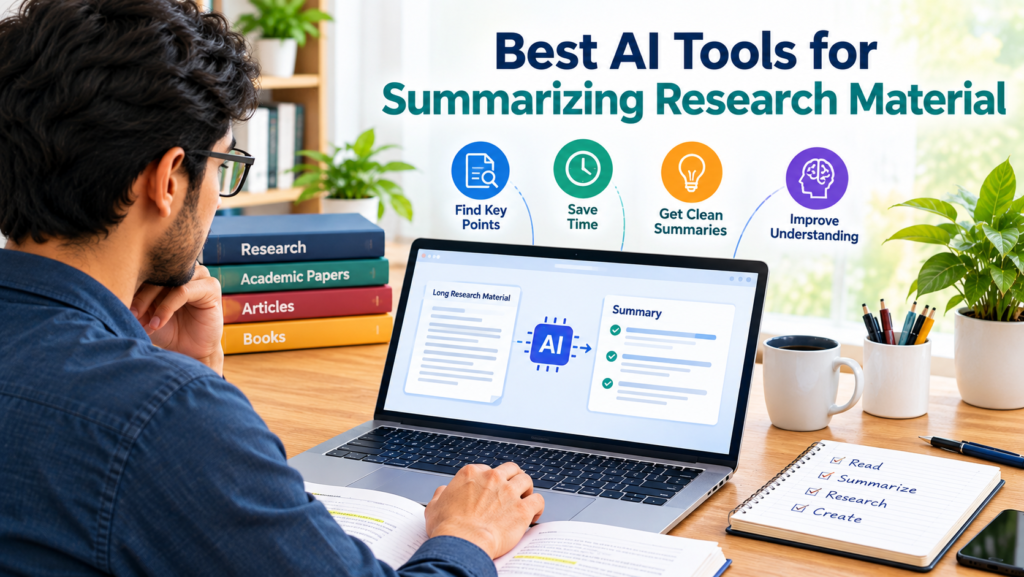
AI summarization tools can read large amounts of text and provide shorter versions that highlight important ideas, findings, arguments, and conclusions. They can help save time and make complex research easier to understand.
However, I do not think AI summaries should completely replace reading the original material. Instead, I see them as a practical way to understand research faster and decide which sources deserve a deeper reading.
In this article, I will discuss some of the best AI tools for summarizing research material and explain how I would use them for research, study, writing, and content creation.
What Is an AI Research Summarizer?
An AI research summarizer is a tool that uses artificial intelligence to analyze text and produce a shorter version of the original material.
Depending on the tool, you may be able to summarize research papers, academic articles, reports, books, webpages, documents, or notes.
A good summary should preserve the main ideas without unnecessary details. For example, instead of reading a twenty page research paper from beginning to end just to understand its basic purpose, I can use an AI tool to get an overview first.
This does not mean that the summary contains everything. Important details, limitations, methodology, statistics, and supporting evidence can sometimes be left out. That is why I always consider an AI summary a starting point rather than the final source.
Why Use AI to Summarize Research Material?
The biggest advantage is time.
Researchers, students, writers, and professionals often have to review many sources before starting a project. Reading every source in detail from the beginning can take a considerable amount of time.
AI can help with the first stage of this process.
For example, I can summarize several research papers and identify their main topics. After that, I can decide which papers are most relevant to my work and read those sources more carefully.
AI summaries can also make difficult material easier to understand. If a paper contains technical language, I can ask an AI tool to explain the main ideas using simpler language.
This can be particularly useful when learning about an unfamiliar subject.
1. ChatGPT
ChatGPT can be useful for summarizing many types of research material. Depending on the available features and file support, users can provide documents or text and ask for summaries, key points, explanations, comparisons, and questions based on the material.
What I like about using a general AI assistant for research is the flexibility.
I do not have to ask for only one type of summary. I can request a short overview, detailed notes, important findings, a list of key terms, or an explanation written for beginners.
For example, after providing a research paper, I could ask:
“Summarize this paper in simple language and identify the research question, methodology, major findings, limitations, and conclusion.”
This gives me a structured starting point.
I can then ask follow up questions about specific sections instead of reading the entire document repeatedly.
2. Claude
Claude is another AI assistant that can be useful for working with lengthy documents and research material.
I find this type of tool useful when I want more than a basic summary. For example, I can ask the AI to explain an argument, compare different sections, identify important themes, or turn research notes into a structured outline.
This can help when working on long reports, academic material, business documents, or other information heavy projects.
One useful approach is to ask for two summaries. The first can be a short overview for quick understanding. The second can focus on important details that I should investigate further.
This gives me both the big picture and a list of areas that deserve closer attention.
3. Google Gemini
Google Gemini can also be useful for summarizing information and working with documents. Its connection with the wider Google ecosystem can make it convenient for people who already use Google services for research, documents, and productivity.
I would use a tool like Gemini when I want to organize information, understand a document, or turn research material into useful notes.
For example, I could ask for the main arguments in a report and then request a list of questions that I should consider before using the information in an article.
This approach changes AI from a simple summarization tool into a research assistant.
4. NotebookLM
NotebookLM is particularly interesting for research because it is designed around working with sources provided by the user.
Instead of simply asking an AI about a general topic, I can provide my research sources and use the system to understand those materials.
This can be useful when working with multiple documents. For example, I may have several reports about the same subject. Rather than reading each document separately and manually comparing them, I can use an AI research workspace to help identify common themes and differences.
For students and researchers, this type of source focused workflow can make research organization much easier.
I still recommend checking the original documents whenever the exact wording, numbers, evidence, or conclusions matter.
5. Perplexity
Perplexity can be useful when research involves finding information as well as understanding it.
One advantage of a research focused AI search system is that it can help connect questions with online sources. This can be helpful during the initial research stage when I am trying to understand a topic and discover relevant information.
For example, if I am researching artificial intelligence in education, I can use an AI research tool to explore major developments, find relevant sources, and then investigate the original material.
The important point is that a generated answer should not automatically be treated as the source itself. I would still open and review the cited sources when accuracy is important.
6. Scholarcy
Scholarcy is designed specifically around summarizing academic and research documents.
This makes it particularly relevant for students, academics, and anyone who regularly works with research papers.
A specialized academic summarizer can help extract important parts of a paper and make a long document easier to review.
I would consider this type of tool useful when my main goal is quickly understanding the structure and important findings of academic papers.
Instead of spending a long time deciding whether a paper is relevant, I can first use a summary to understand its subject and then read the original paper if it is important to my project.
7. QuillBot
QuillBot is widely known for writing and paraphrasing features, but it also provides summarization capabilities.
This can be useful when working with articles, notes, or other text that needs to be shortened.
For example, if I have written several pages of research notes, I can use summarization to create a shorter version that captures the main ideas.
This is especially helpful when preparing presentations or reviewing notes before writing an article.
However, I would always compare the summary with my original notes to make sure important information has not been removed.
How to Choose the Best AI Research Summarizer
The best AI tool for summarizing research material depends on what you are trying to accomplish.
If you want a flexible assistant that can summarize and explain documents, a general AI assistant may be enough.
If you work primarily with academic papers, a specialized research summarization platform may be more convenient.
If you have several documents and want to ask questions specifically about your own sources, a source focused research tool can be useful.
Before choosing a tool, I recommend looking at features such as document support, summary length, citation handling, source references, privacy options, file limits, and the ability to ask follow up questions.
There is no reason to choose a complicated platform if your needs are simple.
How I Use AI to Summarize Research
My preferred approach is to divide research into several steps.
First, I collect the relevant sources.
Next, I use AI to create a basic summary of each source. This helps me understand what each document is about.
After that, I identify the most useful sources and read them in greater detail.
I may then ask AI to compare the sources. For example, I can ask what conclusions they share, where their findings differ, and which questions remain unanswered.
Finally, I return to the original sources before using important facts or statistics in my own writing.
This process saves time while keeping the research grounded in the original material.
Never Trust an AI Summary Blindly
This is probably the most important point in this entire article.
AI summaries can contain mistakes.
An AI system may misunderstand an argument, leave out an important qualification, incorrectly describe a finding, or simplify something that should not be simplified.
For general learning, a small mistake may not have serious consequences. But when writing academic work, professional reports, financial content, medical information, or other important material, accuracy becomes much more important.
Always check important claims against the original source.
If the summary says that a study found a particular result, open the study and confirm it. If an AI tool provides a statistic, verify the statistic before publishing it.
AI should make research faster, not make researchers less careful.
AI Summaries and SEO Content
AI summarization can also be useful for content creators.
For example, before writing an SEO article, I can summarize several reliable sources to understand the major points surrounding a topic.
I can then use that understanding to create an original article with my own structure, explanations, examples, and perspective.
The goal should not be copying summaries from different sources and combining them. That does not create genuinely useful content.
Instead, I prefer using AI summaries as research notes. They help me understand the subject so I can produce content that provides real value to readers.
Benefits for Students
Students can use AI research summarizers in several practical ways.
They can summarize long chapters, simplify complicated concepts, create revision notes, generate questions, and identify important topics for further study.
For example, after reading a research paper, a student could ask AI to create ten questions based on the paper. Answering those questions can help test whether the student actually understands the material.
This is a much better use of AI than simply asking it to complete an assignment.
Final Thoughts
The best AI tools for summarizing research material can save significant time and make large amounts of information easier to understand. ChatGPT, Claude, Gemini, NotebookLM, Perplexity, Scholarcy, and QuillBot can each be useful depending on the type of research and the workflow involved.
From my point of view, the most effective approach is to use AI for the first stage of research rather than relying on it for everything.
Let AI help you identify key ideas, organize information, compare sources, and understand difficult material. Then go back to the original sources when accuracy and context matter.
A good research process still requires human judgment. AI can summarize a paper in seconds, but you are the person who needs to decide whether the summary is accurate, whether the source is reliable, and whether the information is appropriate for your work.
When used carefully, AI research summarizers can turn a large pile of information into a much more manageable starting point. They can help students study more efficiently, help writers research topics faster, and help professionals understand lengthy documents without wasting unnecessary time.
The real benefit is not simply getting shorter text. The real benefit is getting to the important information faster while still keeping your own critical thinking at the center of the research process.
