 adsenservice
Related Articles


Online research has become a regular part of my work. Whether I am writing an article, learning about a new topic, checking information, studying a subject, or preparing content for a website, I often need to search through a large amount of information.
The problem is that traditional online research can sometimes take a lot of time. I may have to open many websites, compare different sources, read long articles, and then organize the useful information.
This is where AI tools for online research can make the process easier. Modern AI research tools can help me find information, summarize documents, discover sources, compare ideas, and organize notes. However, I do not think AI should replace careful research. Instead, I use it as a research assistant that helps me work faster while I remain responsible for checking important information.
In this article, I will discuss some of the best AI tools for online research and explain how I can use them effectively.
What Are AI Research Tools?
AI research tools are applications that use artificial intelligence to help with information discovery and analysis. Depending on the tool, they can search the web, summarize information, answer questions, analyze documents, find academic papers, or organize research notes.
What I find useful about these tools is that they can reduce the amount of manual work involved in research.
For example, instead of searching for ten different articles and reading every paragraph, I can use an AI research tool to get an overview first. I can then open the original sources and examine the information that matters most.
1. ChatGPT
ChatGPT is one of the AI tools I find useful for many different research tasks. I can use it to brainstorm research questions, explain complicated topics, summarize information, organize notes, compare concepts, and help create research outlines.
One of its biggest advantages is flexibility. I can ask a simple question and then continue with follow up questions based on the response.
For example, if I am researching artificial intelligence, I can start by asking:
“Explain the main uses of artificial intelligence in small businesses.”
Then I can ask:
“Give me examples of these uses.”
After that, I can ask:
“What questions should I investigate before writing an article about this topic?”
This type of conversation can help me explore a subject from different angles.
I still verify important facts using reliable original sources because an AI response should not automatically be treated as a primary source.
2. Perplexity
Perplexity is designed around AI powered search and research. I find this type of tool particularly useful when I want a direct answer along with sources that I can investigate further.
Instead of simply receiving a traditional list of search results, I can ask a research question and review the answer with its cited sources.
This can save time during the early stage of research because I can quickly understand the general topic before exploring individual sources.
For example, I could ask:
“What are the major trends in online education?”
The response can help me identify areas that deserve further research.
I would still open the cited sources and check whether the information actually supports the claim I want to use.
3. Google Gemini
Google Gemini can also be useful for research, especially for people who already use Google’s ecosystem.
I can use it to explore topics, summarize information, brainstorm research questions, and work with different types of content depending on the available features.
One thing I like about AI research is the ability to move from a broad question to more specific questions quickly.
For example, I might start with:
“How does renewable energy work?”
Then I can ask:
“Explain solar energy in simple language.”
Then:
“What are the main challenges of solar energy?”
This makes it easier to build my understanding step by step.
As with other AI tools, I would verify important claims before using them in an article or professional project.
4. NotebookLM
NotebookLM is particularly interesting when I already have research material and want AI to help me understand it.
Instead of simply asking an AI tool about a general subject, I can work with specific sources and use AI to summarize or explore the material.
This can be useful when dealing with reports, documents, research papers, notes, or other source material.
For example, if I have several documents about a particular subject, I can use an AI research notebook to help identify important themes and questions.
This can save me time because I do not always have to manually search through every section before understanding the overall structure of the material.
However, I still prefer reading the original documents when the details are important.
5. Elicit
Elicit is designed specifically around research and academic literature. I would consider it when I need to find and understand research papers rather than simply looking for general web information.
Academic research can be difficult because there may be hundreds of papers related to a single topic. Finding relevant studies and understanding what they discuss can take considerable time.
Tools designed for academic research can help organize this process.
Elicit can be useful for discovering research papers, extracting information, and comparing findings.
For students, writers, and researchers working with academic material, this type of AI research tool can provide a useful starting point.
I would still read the original papers before making important academic claims.
6. Consensus
Consensus is another research focused AI tool that can be useful when looking for information from scientific studies.
I find tools like this interesting because they focus more heavily on research literature rather than general internet content.
For example, if I have a question related to a scientific topic, I can use a research platform to explore what published studies say about it.
This can help me move beyond general articles and find research that may provide stronger evidence.
However, research findings can be complicated. A single study does not necessarily represent the complete scientific understanding of a subject. That is why I prefer looking at multiple relevant sources before reaching a conclusion.
7. Claude
Claude can also be useful for online research, particularly when I have long documents or large amounts of text that I want to understand.
I can provide research material and ask for a summary, key points, comparisons, questions, or an organized outline.
For example, I might ask:
“Summarize this report in simple language and identify the five most important points.”
I can then ask follow up questions about specific sections.
This type of workflow can make long documents easier to understand and can help me prepare notes before writing.
The important thing is to distinguish between summarizing a source and independently verifying its claims.
How I Use AI for Online Research
I prefer using AI research tools in several stages.
First, I use AI to understand the basic topic. This helps me identify important terms and concepts.
Second, I use search and research tools to find relevant sources.
Third, I open the original sources and check the information.
Fourth, I organize the important points into notes.
Finally, I use AI to help create an outline or explain difficult concepts before writing the final content myself.
This workflow allows AI to save time without making the research process completely dependent on AI generated answers.
Always Check Your Sources
One of the most important things I have learned about AI research is that convenience should not replace verification.
AI can sometimes misunderstand information, provide incomplete answers, or present an incorrect statement with confidence.
For general topics, this may only create a small problem. But for financial, medical, legal, scientific, academic, or business information, checking reliable sources is especially important.
I prefer going back to the original source whenever a claim is important.
If an AI tool gives me a statistic, I want to know where the statistic came from. If it mentions a study, I want to find the study. If it makes a claim about a company or product, I want to check an appropriate primary source.
How to Write Better Research Prompts
The quality of an AI research response often depends on the prompt.
Instead of asking:
“Tell me about social media.”
I can ask:
“I am researching how social media affects small businesses. Explain the main benefits and challenges, identify important areas I should investigate, and suggest reliable types of sources I should look for.”
This gives AI a much clearer direction.
I can also tell the tool whether I am a beginner, student, writer, marketer, or business owner. Adding context helps me get more relevant information.
AI Research Tools Do Not Replace Human Judgment
I think this is one of the most important points to remember.
AI can process information quickly, but research still requires judgment.
I need to decide whether a source is trustworthy, whether evidence supports a claim, whether information is current, and whether different sources disagree.
AI can help me identify these questions, but I should not blindly accept every answer.
The best results usually come from combining AI assistance with human reasoning and reliable sources.
Final Thoughts
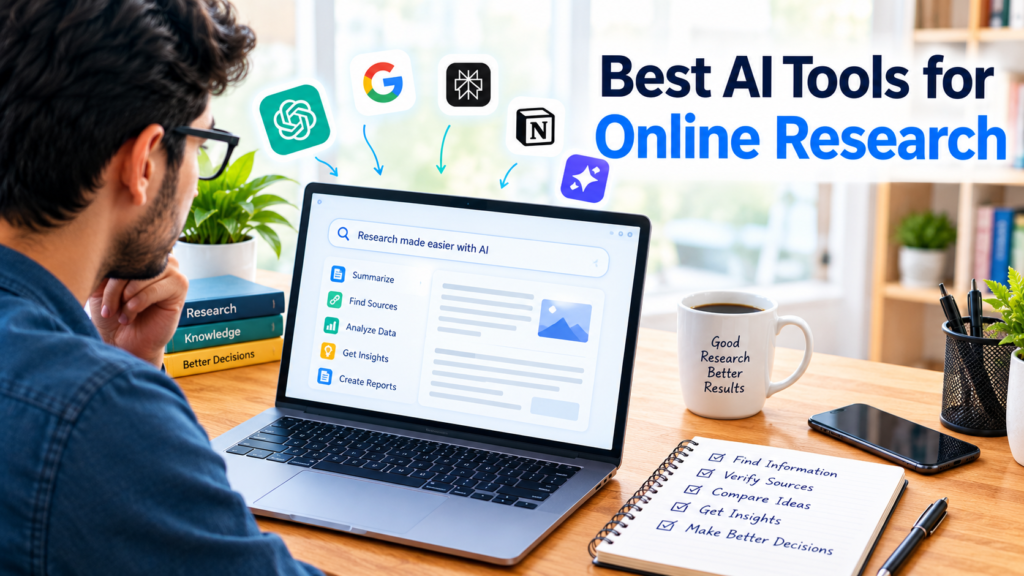
The best AI tools for online research can make information gathering faster and more organized. Tools such as ChatGPT, Perplexity, Google Gemini, NotebookLM, Elicit, Consensus, and Claude can each be useful for different types of research.
For general research, I can use AI to explore ideas, understand difficult topics, create research questions, summarize information, and organize notes.
For academic or scientific research, specialized tools can help me discover and examine research literature.
However, I believe the most effective approach is to use AI as a research assistant rather than treating it as the final authority.
AI can help me find information faster, but I still need to check sources, compare evidence, and use my own judgment. When I combine the speed of AI with careful human research, I can save time while producing information that is more useful, accurate, and trustworthy.
That balance is what makes AI tools for online research so valuable.
